

R&D LAB Method Shipped Built for our own pilot projects
Contradiction
TRIZ as a working instrument
State what has to improve and what gets worse when it does. You get the principles that resolved that exact pair, and the inventions that did it.
- 1 248populated matrix cells
- 40inventive principles
- 22worked case studies
- 19of them with a patent number
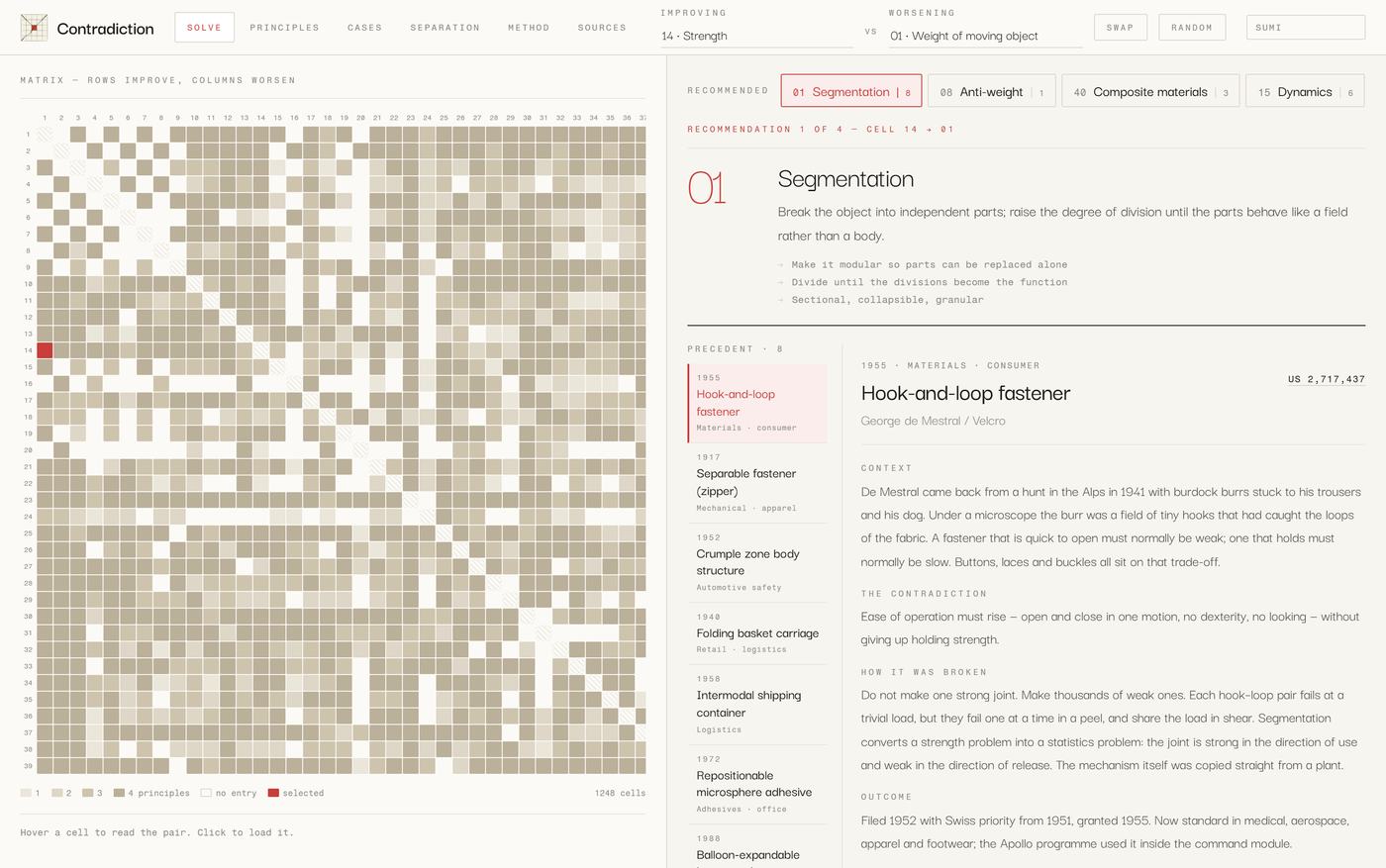
Pick improving against worsening and the cell answers with principles and with inventions that broke that exact pair. Here: strength against weight, resolved by Segmentation.
Why this is published
Every consultancy claims to have a method. This is our TRIZ application, built as an instrument rather than a slide: a trade-off goes in, a set of resolutions comes out, and most of them rest on an invention with a patent number. We built it for our own pilot projects, because a workshop needs something after the brainstorming and a slide deck does not supply it.
TRIZ, the theory of inventive problem solving, goes back to Genrich Altshuller: he read a great many patents and found that the same handful of moves keeps resolving the same recurring trade-offs. The contradiction matrix that came out of it is usually printed as a lookup table and left there. We turned it back into a working instrument: pick the pair, get the principles, then read a case that broke that exact contradiction, in most cases with the patent record to check it against.
The idea
Altshuller's observation, and why it usually ends up as a table
A technical trade-off is the sentence every engineering team says sooner or later: if we make X better, Y gets worse. Stronger but heavier. Faster but less accurate. Packed tighter but hotter. The sentence feels like a law of nature, and that is exactly the damage it does: it closes the discussion instead of opening it.
From 1946 onwards Genrich Altshuller read a great many patents and found something unexpected. Inventions from entirely different fields resolve the same trade-off again and again with the same handful of moves. He collected the moves into forty inventive principles and entered the pairs into a table of 39 rows and 39 columns. The row is what has to improve. The column is what gets worse when it does. The cell holds the principles that historically resolved that pair.
What that table becomes in practice is usually a printout. You look up a cell, you get up to four numbers, and on their own the numbers say nothing. „Segmentation“ stays a slogan until somebody shows how it broke a real problem. This is why TRIZ dries up in so many workshops at exactly the point where it should be starting.
Contradiction is our answer to that. The matrix stays the entry point, but it is not the result. Behind every cell are principles, behind every principle are worked cases, behind most cases a patent number you can look up yourself, and a movable model of the physics involved. The whole thing is a single HTML file that opens without a network.
The matrix is a prompt, not an oracle. It only becomes useful once there is a case behind the cell.
The mechanism
From the parameter pair to the precedent
- What has to improveone of 39 parameters
- What gets worseone of 39 parameters
- Principlesone to four, ordered by frequency
- Precedentsmostly with a patent number to look up
- Separationwhen both sides are the same property
The instrument invents nothing. It shortens the road from „we are stuck here“ to three named precedents you can argue about. That is where a pilot workshop starts.
The procedure
How a trade-off runs through the instrument
- 01 Write the trade-off as a sentence „If X rises, Y gets worse.“ If you cannot write that sentence you do not have a trade-off, you have a complaint. Name the physical quantity, not the symptom.
- 02 Map both sides onto parameters The 39 parameters are coarse and date from the 1960s and 70s. The friction of mapping onto them is often itself the clue to where the real problem sits. Try two or three mappings and compare what comes back.
- 03 Read the cell The cell returns one to four principles, ordered by how often they resolved that pair. 726 of the populated cells carry four, 58 carry exactly one. A single principle is not a weaker answer, it is a narrower one.
- 04 When the cell is empty 234 of the 1,482 pairs are unpopulated. That is not a defect but a missing pattern in the 1960s and 70s patent sample. A neighbouring parameter, swapping the two sides, or the route via separation will help, and the application offers all three.
- 05 Read the case, do not believe the principle Every principle leads to worked inventions: context, the contradiction in plain words, how it was broken, the outcome, in most cases the patent number. Read the shape of the move, not the finished answer.
- 06 When the pair is really one thing If the same property has to be both high and low, the matrix has nothing to say, which is why the diagonal is empty. That is what the separation module is for: by space, by time, between whole and parts, or by condition.
The printed table and this instrument
The matrix as a printout
- A cell returns up to four numbers and stops there.
- Whether a principle ever resolved anything is nowhere on the page.
- 234 of the 1,482 pairs are empty, with no word on why.
- The empty diagonal looks like a defect in the table.
- The physics behind a move stays prose.
- What the table does not cover, it does not say.
Contradiction
- The cell leads on to principles, cases and evidence.
- 22 cases are worked out, 19 of them carry a patent number.
- Empty cells offer the route via a neighbouring parameter or via separation.
- The empty diagonal is explained and leads into the separation module.
- Every case carries a movable model of the physics involved.
- A method section states first what the table does not do.
A principle is only usable once a case hangs off it
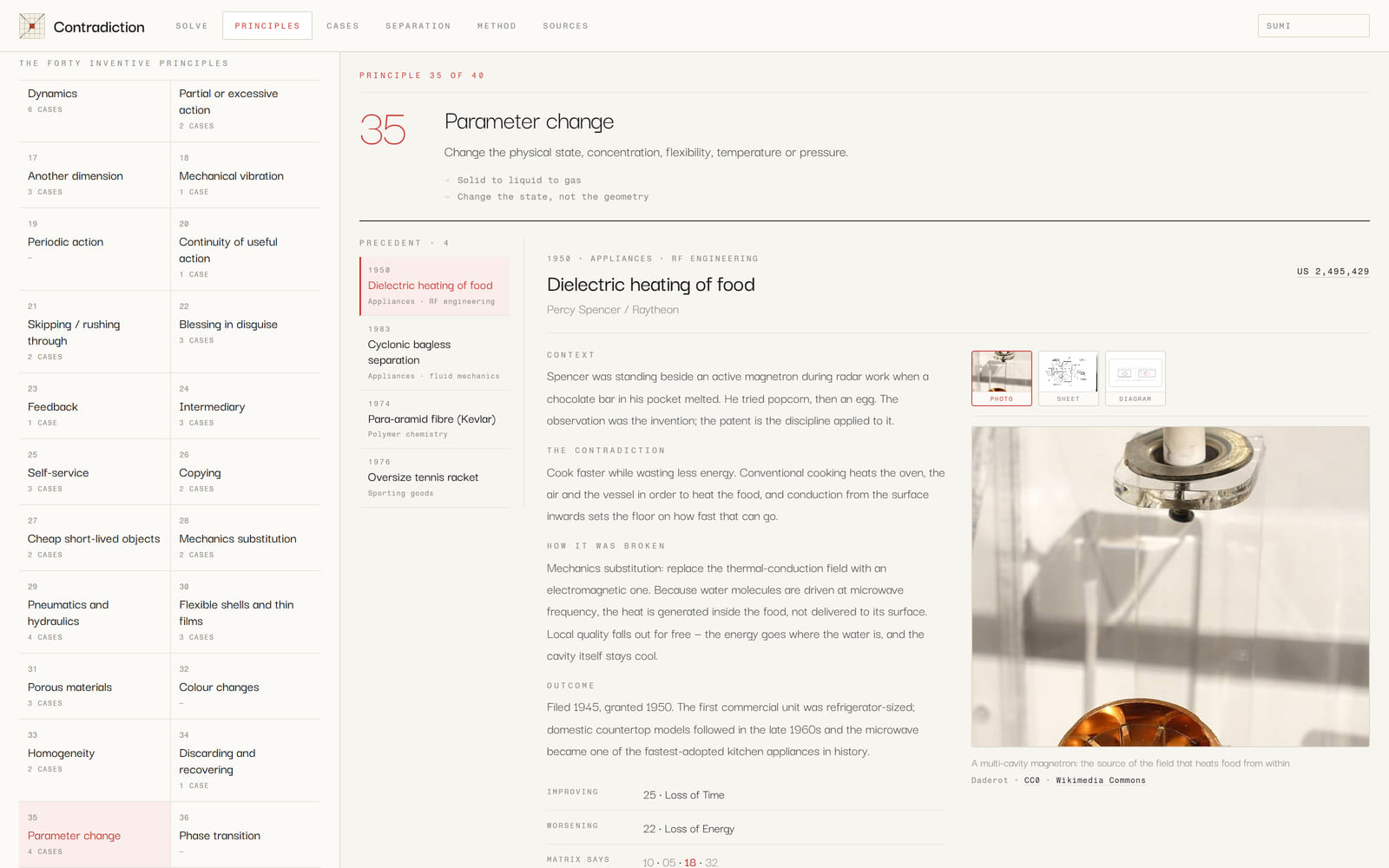
„Parameter change“ sits in the list as principle 35 and on its own says almost nothing. It becomes interesting at Percy Spencer: cook faster while wasting less energy. Conventional cooking heats the oven, the air and the vessel, and conduction from the surface inwards sets the ceiling.
The move is a change of field. Instead of a conduction field, an electromagnetic one that drives the water molecules inside the food directly. The heat appears inside rather than outside, and the cavity itself stays cool. Filed 1945, granted 1950; the patent number is in the case and linked.
Every case also shows two rows side by side: which principles the matrix cell would have named for that exact pair, and which ones the inventor actually used. The two lists often overlap only in part. That is not smoothed over, because the divergence is the most honest part of the thing.
What lies behind a cell
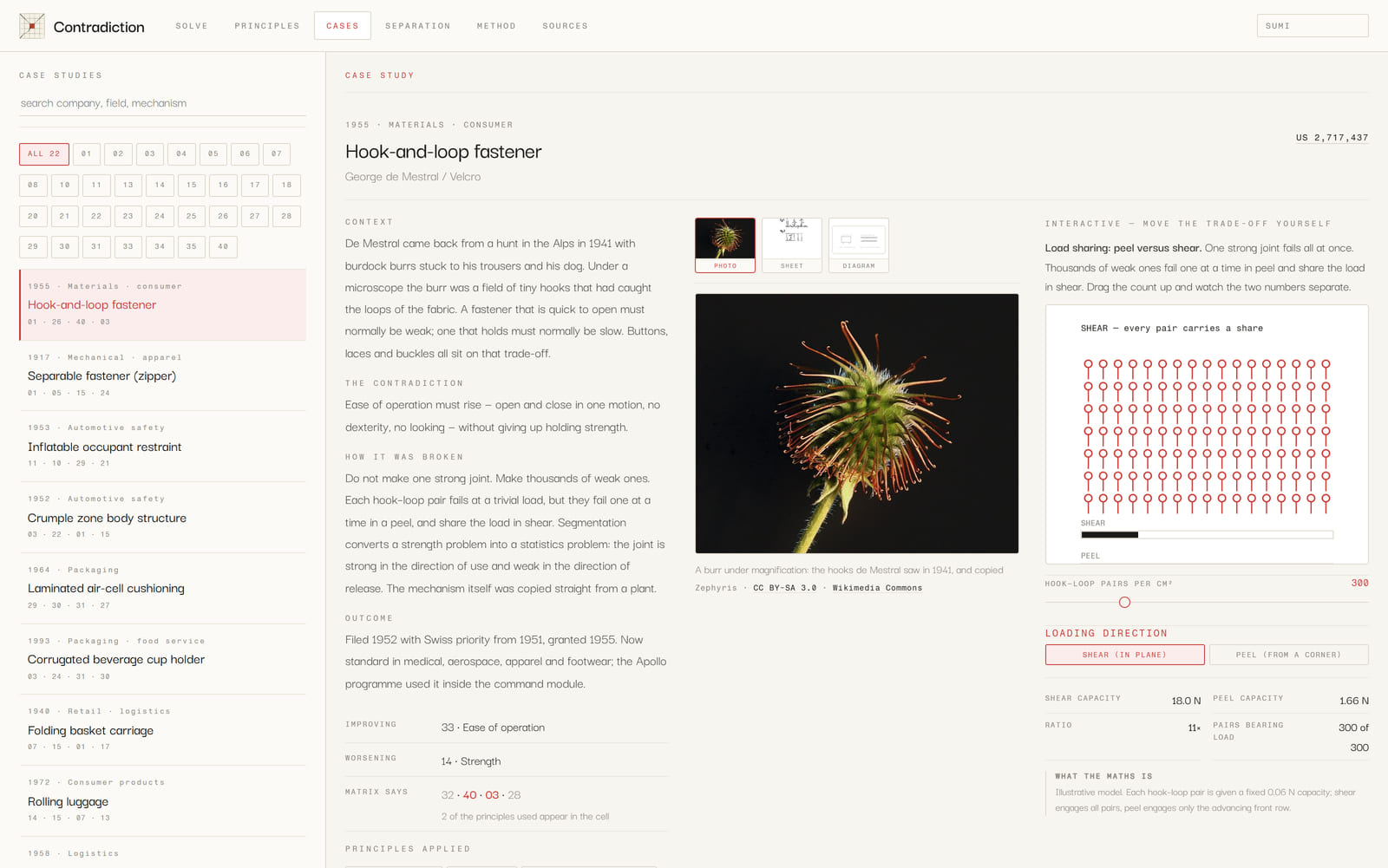
The cover image of this page shows the road there: strength against weight, cell 14 onto 01, four principles. This is the destination of that road. De Mestral came back from a hunt in 1941 with burrs on his trousers, saw a field of tiny hooks under the microscope and answered „must open easily, must hold firmly“ with it: not one strong joint but thousands of weak ones. That turns a strength problem into a statistical one.
On the right the same thing sits as a movable model. At 300 hook-and-loop pairs per square centimetre the joint carries roughly 18 N in shear and roughly 1.66 N in peel, a ratio of about eleven to one. The model calls itself illustrative and writes its assumption underneath. Below the running text it also shows what the matrix cell would have named: two of the four principles actually used appear there, two do not.
The limits, first
What the instrument says about itself
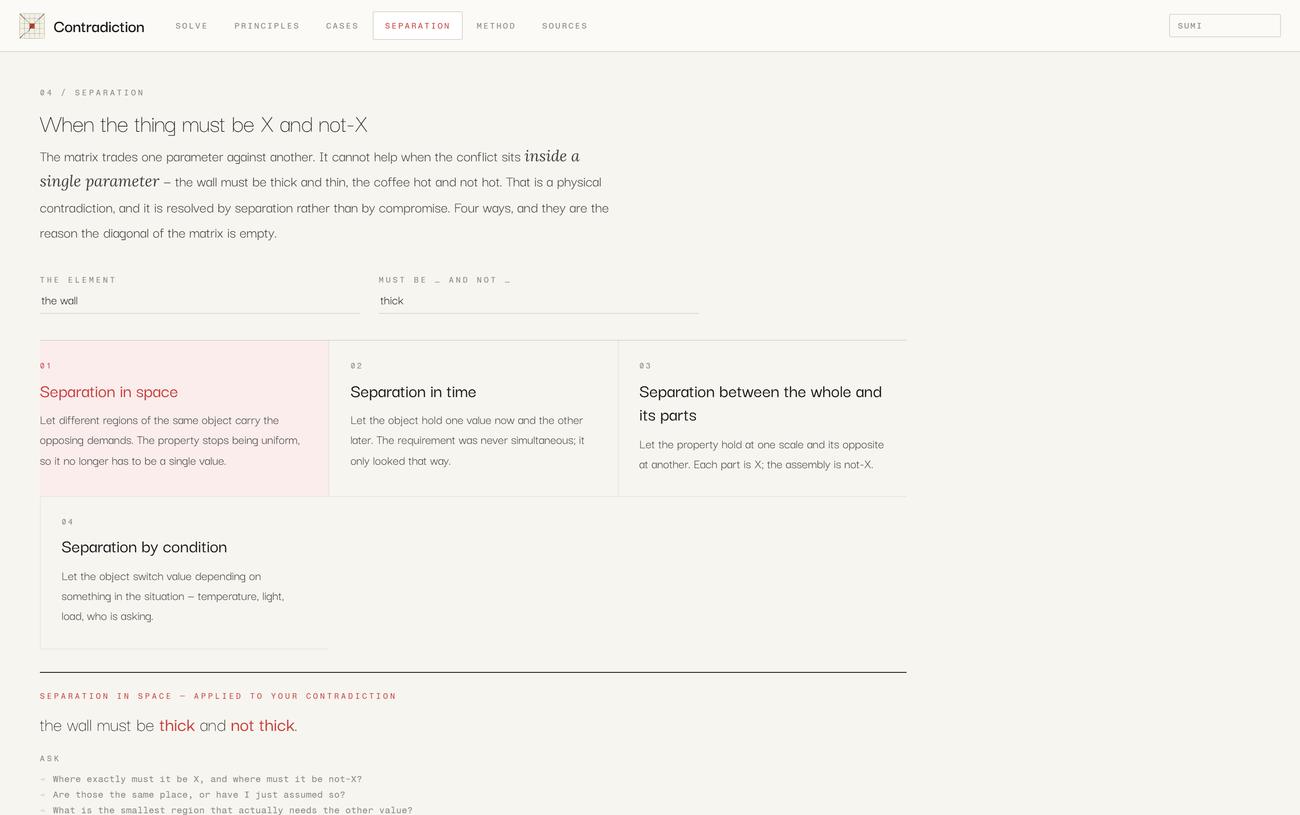
SeparationWhen the same property has to be present and absent at once, no row of the table helps. You separate by space, by time, between whole and parts, or by condition, and the module puts your own sentence into the questions.
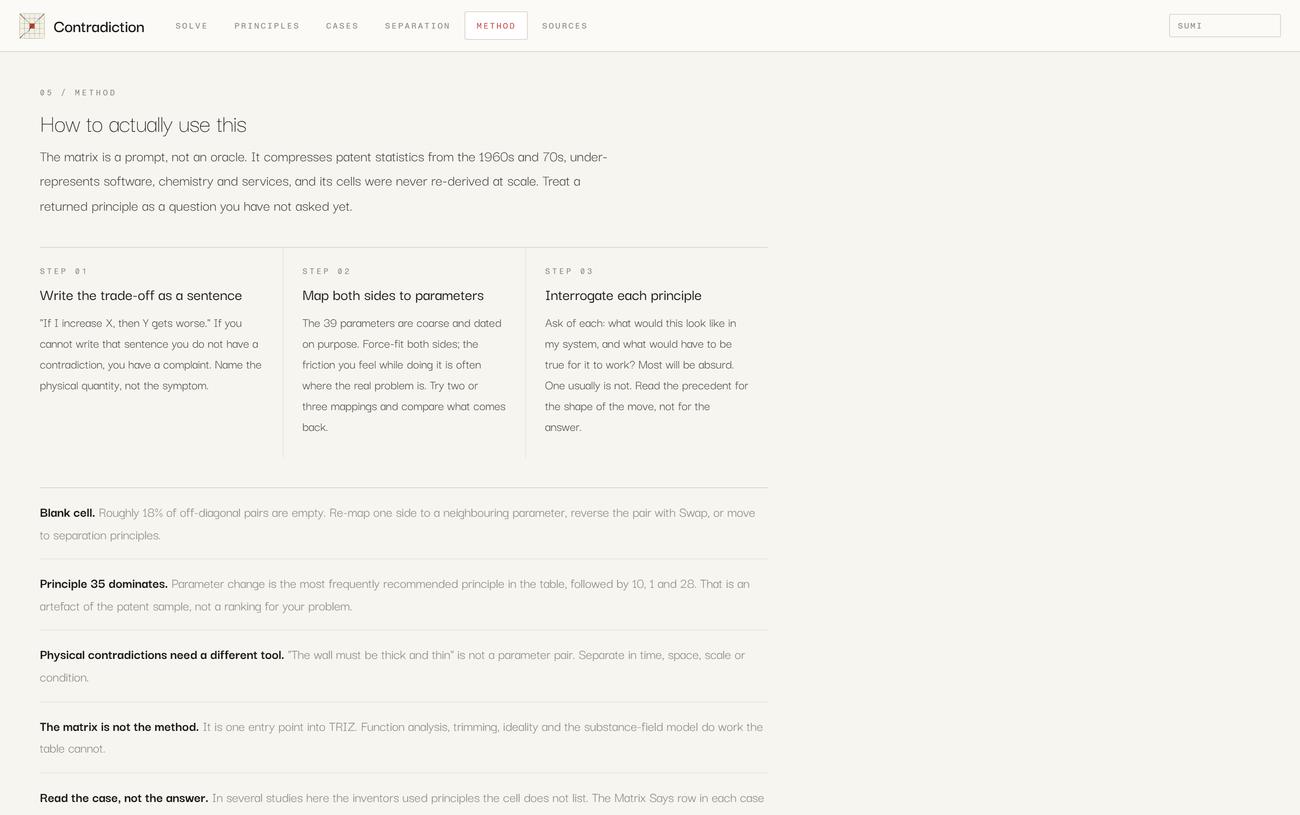
MethodThe method section names the limits first: the table is a prompt, not an oracle. It comes from a 1960s and 70s patent sample, under-represents software, chemistry and services, and it is not the method but one way into it.
Under the bonnet
Where this fits
- An engineering team stuck on a trade-off that keeps producing the same discussion.
- Innovation workshops that need a structured next move after the brainstorming.
- Design reviews where „that is physically impossible“ deserves a second look.
- Handing a method over to a client team instead of demonstrating it to them.
Origin of the method: TRIZ, the theory of inventive problem solving, was developed from 1946 onwards by Genrich Saulovich Altshuller (1926-1998) and his colleagues out of the analysis of patents. The contradiction matrix, the 39 parameters and the 40 inventive principles are his work, and this application would not exist without them. We make no claim on the method. Ours is only this implementation: the presentation, the selection and research of the cases, the movable models and the texts. Image credit: screenshots of our own application. The photographs visible inside them come from Wikimedia Commons and are shown in the application with author, licence and source page.
Why this is published
What this means for your project
More from the lab
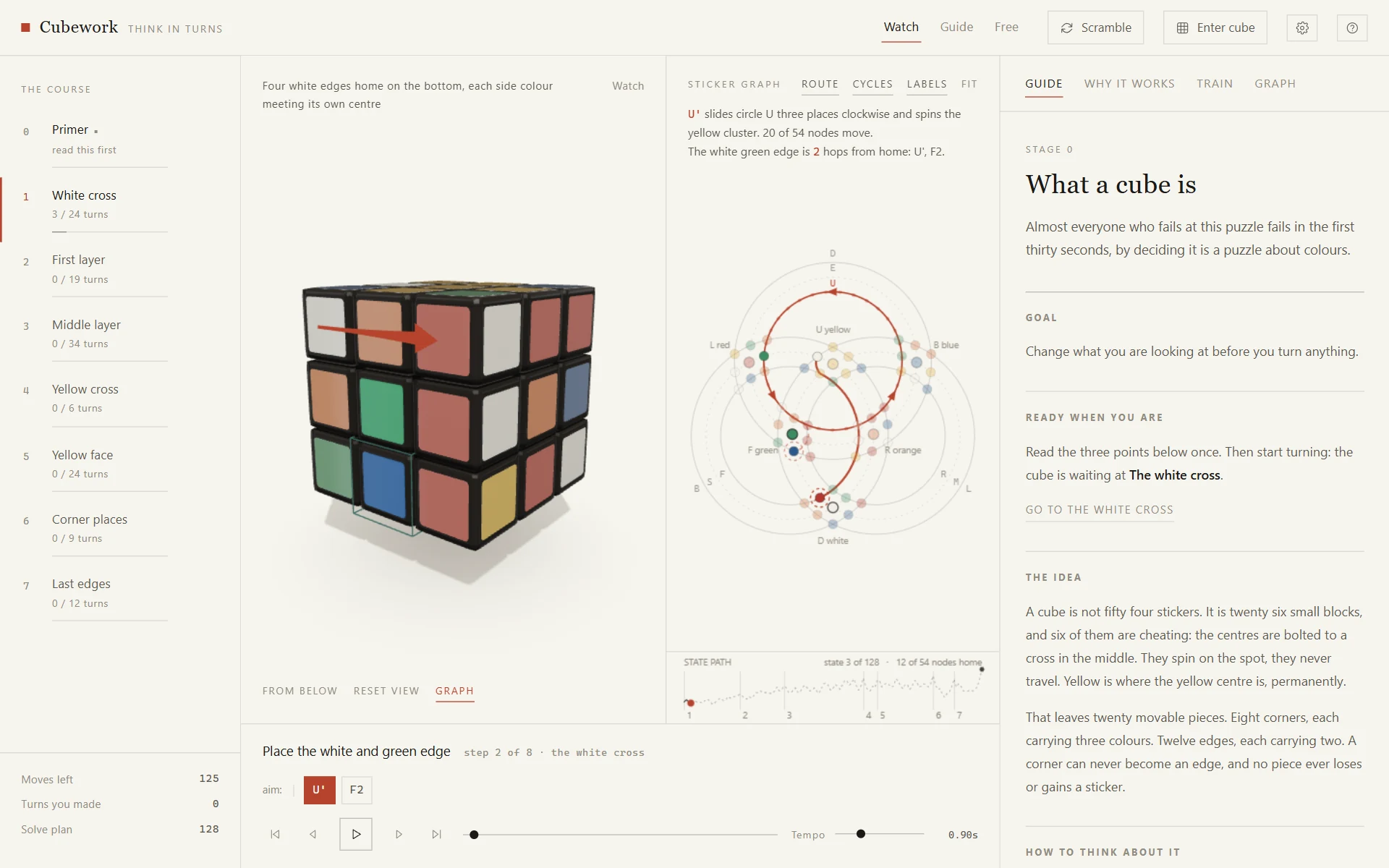
 Method Event Scout A language model reads the event pages; everything else is fixed code. What remains is a short list of where a day in person is worth it.
  Applied Research Vellum Edges, perspective, light and text are all worked out on the phone. A document leaves the device only when someone sends it.
 Stuck on a trade-off that will not move? That is exactly what a pilot is for.
Get in touch