

R&D LAB Method Complete, not published Learning instrument
Vedic Maths: Sutra Lab
Vedic Maths, thirty-nine calculation rules as machines you can turn
Vedic Maths is a 1965 rulebook, not an ancient inheritance. Thirty-nine of its calculation methods, each a parametric machine with animation, derivation and drill, in one HTML file.
- 39methods, each its own module
- 16 + 13sutras and sub-sutras, fully covered
- 202procedure items, each bound to a step
- 1HTML file, no build step
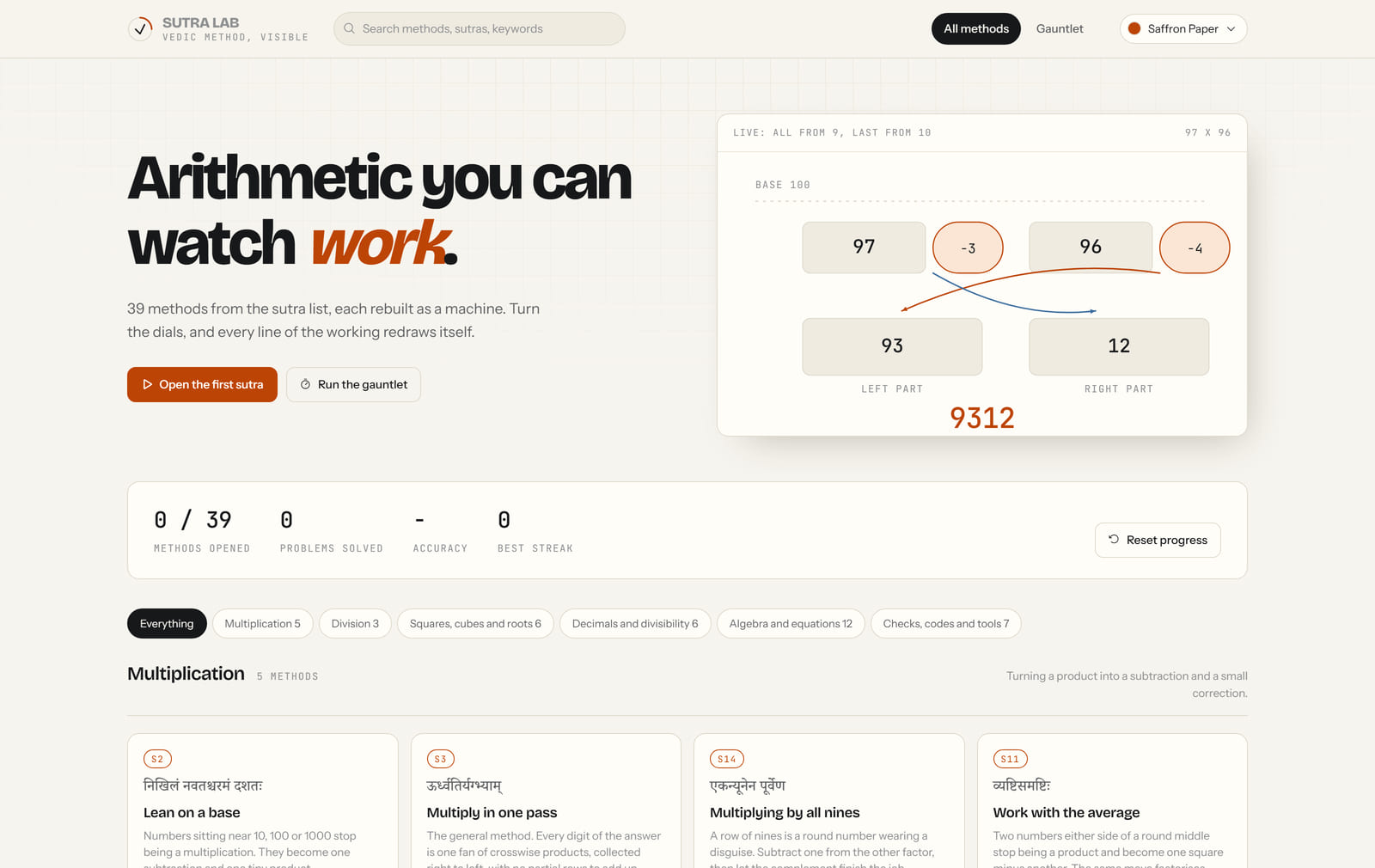
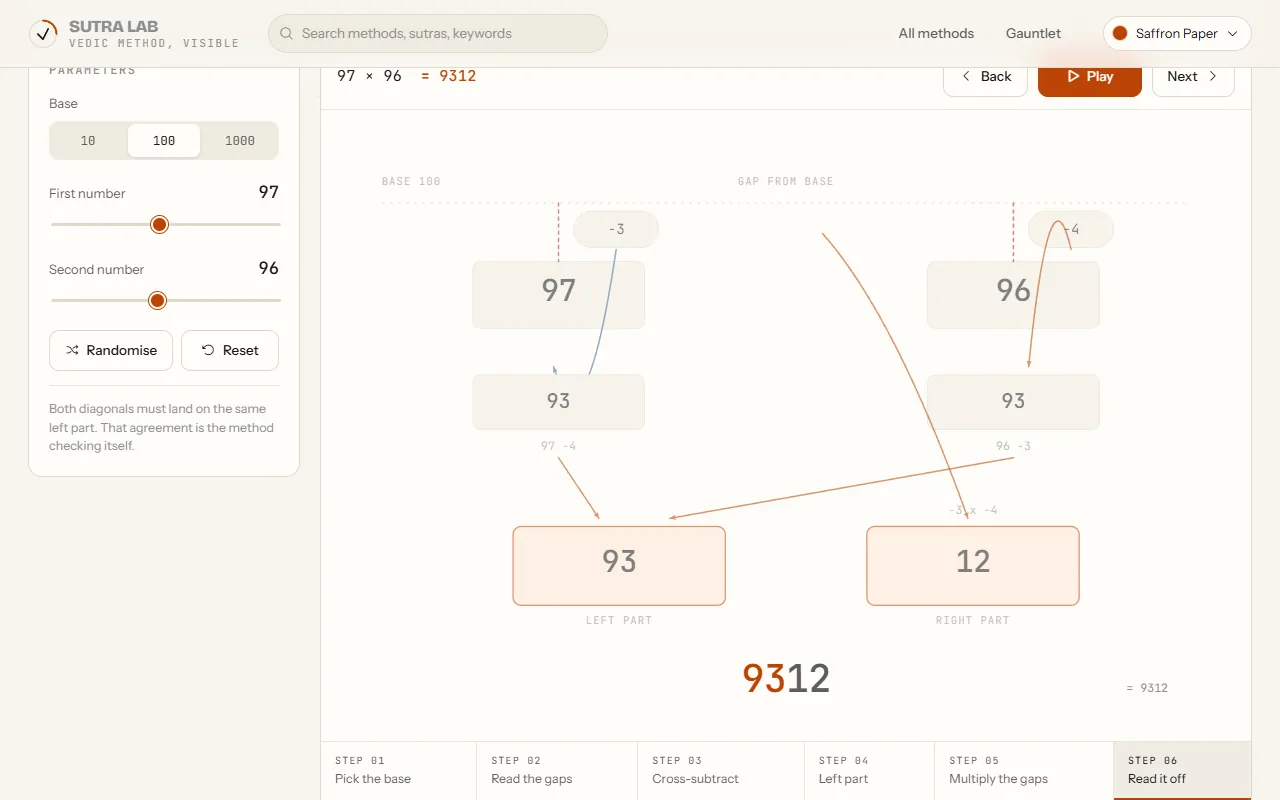
Rule S2, Nikhilam, computing 97 × 96 in one run: base 100, the gaps −3 and −4, the cross-subtraction to 93, the gap product 12, the result 9312. Each step arrives on its own and the timeline marks the one currently running.
Why this is published
Rule systems are our daily working material: test procedures, configuration logic, funding rules, calculation methods. Sutra Lab shows how we make one readable, as a model someone can operate, in which every number on screen comes from the same computation that places the drawing. For a client project that means technical communication, interactive explainers and small rule engines, built from the source rather than from a summary of it. It also means the limits of a method sit inside the tool instead of in a footnote.
Vedic Maths sounds ancient and is not. What runs under the name is a twentieth-century rulebook: sixteen sutras and thirteen sub-sutras for mental calculation, gathered by Bharati Krishna Tirtha and published in 1965. Set the origin claim aside and something usable remains: thirty-nine calculation methods, each a special case of an ordinary algebraic identity, several of them genuinely faster than the school procedure. Sutra Lab takes that rulebook and rebuilds it. Every rule becomes a machine with sliders: change the numbers and the whole drawing, the sequence of steps, the working lines and the derivation recompute. Beside it sits a second document, The Sutra Ledger, which carries the same rules as text and states the provenance question rather than stepping around it. Together they are our evidence for how a rule system can be turned into an instrument someone can operate, without carrying along a claim that does not hold.
Thirty-nine machines, one contract
Every method is an object with the same seven fields: parameters, a compute function, a draw function, a procedure in plain words, a derivation, a drill and a warning function for the range. All thirty-nine modules carry all seven. The step engine and the stage know no individual method, they know only this contract.
That is why thirty-four further modules could be added after the first five without touching the machinery underneath. That is the real work in a tool like this: not the animation, but the question of what all the cases have in common.
The index groups the methods into six families: multiplication 5, division 3, squares, cubes and roots 6, decimals and divisibility 6, algebra and equations 12, checks and codes 7.
From rule to instrument
How a sutra becomes a machine
- 01 Read the rule Sanskrit, transliteration, literal meaning. The aphorism names the move, not the procedure. Nikhilam means all from nine and the last from ten, which is not yet an instruction.
- 02 Find the identity behind it Behind every rule sits an ordinary algebraic identity that makes it true. For Nikhilam it is the expansion of (B+d1)(B+d2). Without that identity there is nothing to draw and nothing to prove.
- 03 Name the parameters What may the reader turn, and between what limits? For Nikhilam it is the base and two numbers whose permitted range depends on the base chosen. Bounds may be functions of other parameters.
- 04 Write the calculation as a trace The compute function returns no result but a sequence of steps. Each step carries a title, its narration, the line for the working column and the number of the procedure item that currently applies. Across all modules that is 202 procedure items.
- 05 Hang the drawing off the same step numbers The draw function builds the SVG from that same trace and throws it away on every parameter change rather than diffing it. No retained scene graph, and therefore a whole class of stale-state bugs removed.
- 06 Add the limit and the drill All thirty-nine modules carry their own warning function saying where the method stops paying off, and a drill that generates a fresh question of the same type and checks the answer itself.
How a module is built
One object drives the stage, the procedure and the drill at once
- Parameterssliders and switches whose bounds may depend on each other
- Rule textSanskrit, transliteration, literal meaning, procedure
- Range checkone warning function per module, naming the limit
- StageSVG, rebuilt from scratch on every parameter change
- Timelineone step per line of the working
- Working columnthe lines a person would write out by hand
- Drilla fresh question of the same type, with its own matcher
The compute function returns a trace of steps. Each step carries its narration, the line for the working column and the pointer to the procedure item that currently applies. The draw function hangs its groups off the same step numbers. That is why the picture and the text cannot drift apart: there is only one source.
The same machinery, three unlike jobs
Three of the thirty-nine
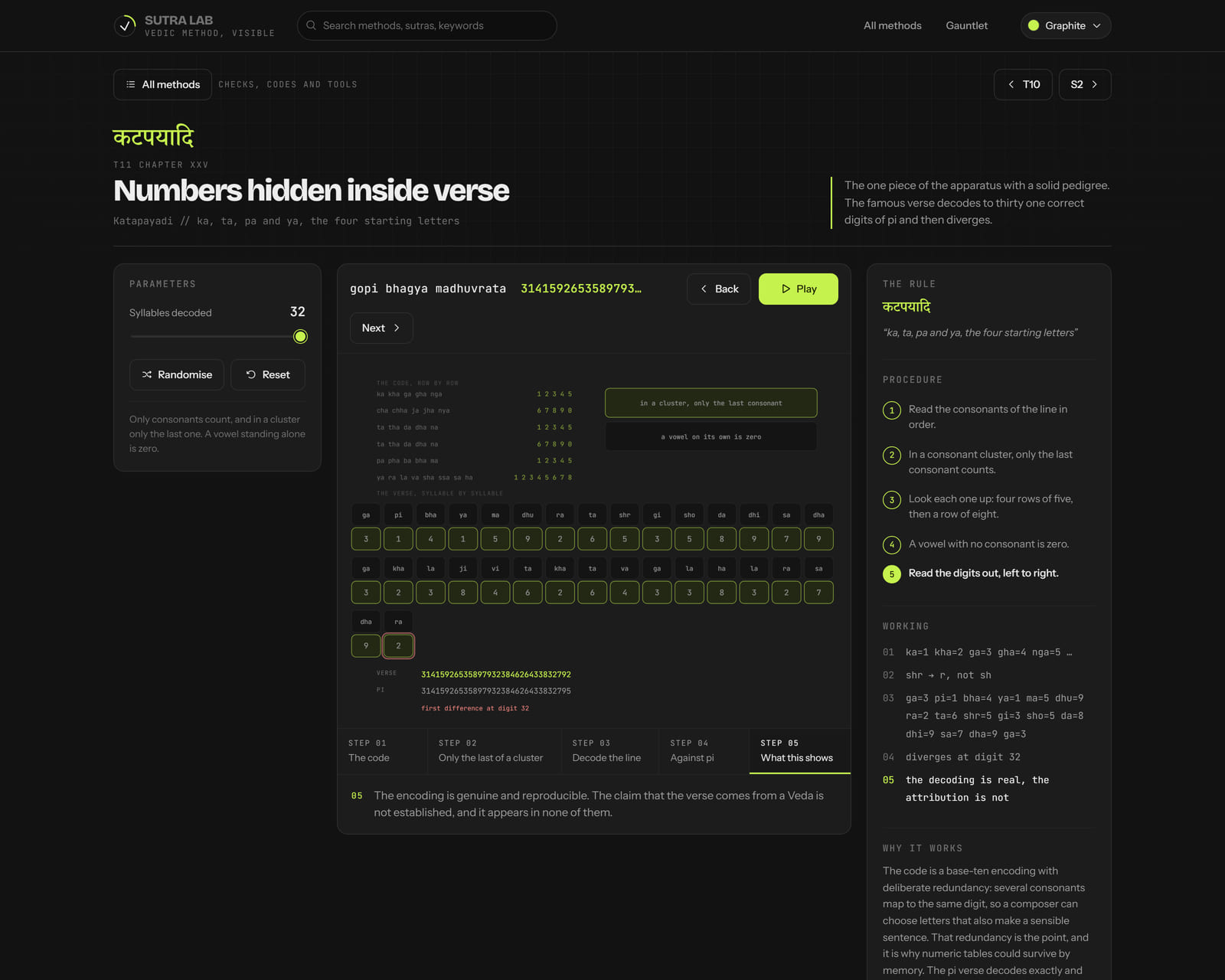
Numbers inside verseThe Katapayadi system encodes digits in consonants. The well-known verse yields thirty-one correct digits of pi and diverges at the thirty-second. The module writes both down, the encoding and the divergence, and says in the same panel that the encoding is genuine while the attribution to a Veda is not.
Roots, digit by digitHere the contract did not quite carry. The source's digit rule needs more lookahead than a single step provides. So the module computes the digits exactly up front and then shows the accompanying bookkeeping line by line, with the rule stated plainly beside it. That admission sits in the module, not in a footnote.
Proof and drillThe product as an area: the base square as the bulk of it, the two gaps as strips on the edges, the corner as the only piece left over. Beside it the same decomposition as lines, carrying the same numbers as the stage above. The drill generates a fresh question, checks the answer itself and keeps count of solved, accuracy and streak.
The second document, which states the provenance
Beside the application sits a static rulebook, The Sutra Ledger. It carries twenty-nine named rules, the sixteen sutras and the thirteen sub-sutras, plus thirteen derived techniques the book develops but never names. Each one comes with the modern identity that makes it true.
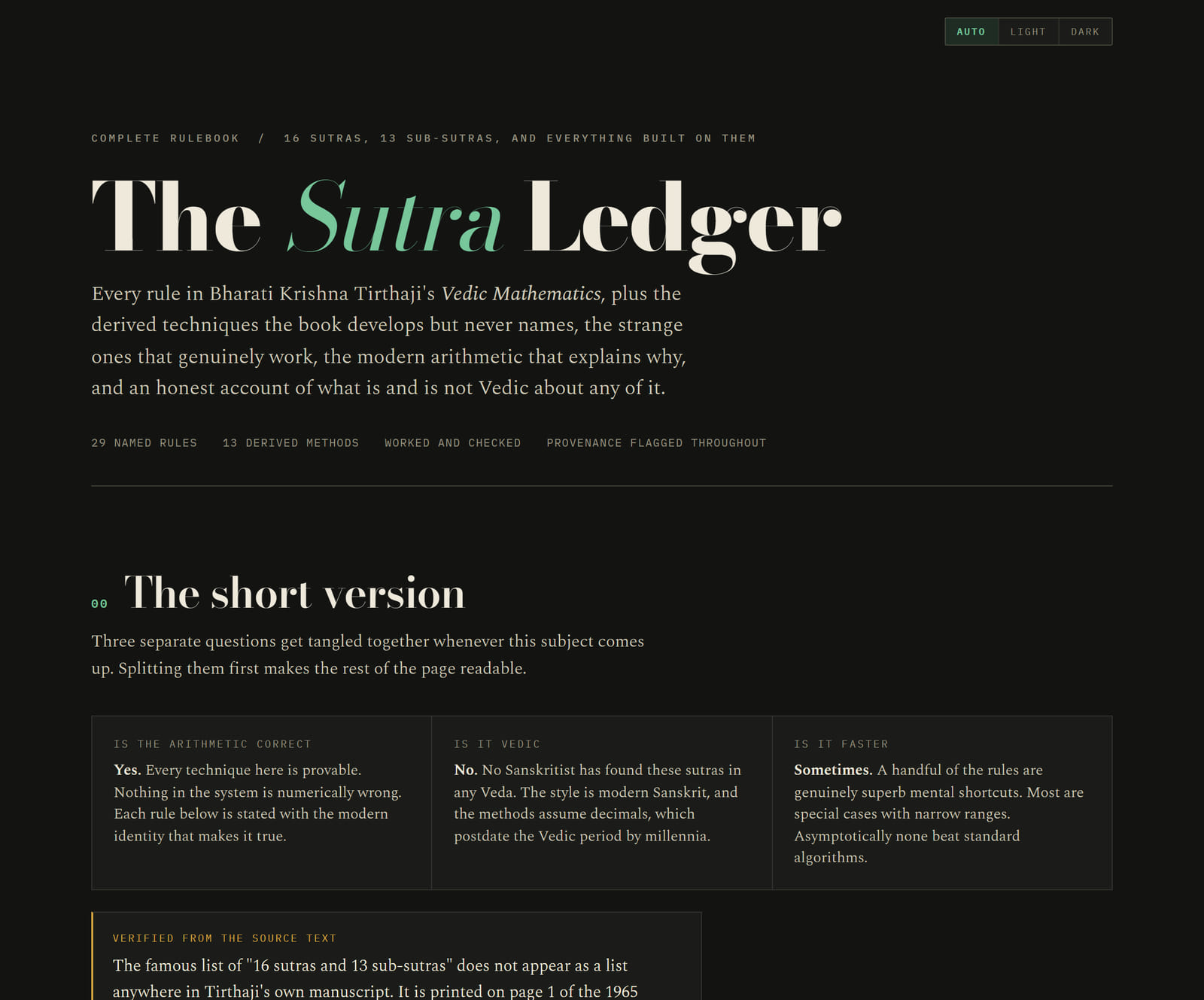
Before the first rule stands the title page with three answer cards: whether the arithmetic is correct, whether it is Vedic, whether it is faster. The document answers them one at a time before it begins.
The question before the build
Correct, not Vedic, sometimes faster
Three questions regularly collapse into one on this subject. Asked separately they have three different answers, and only that separation makes the material usable at all.
Is the arithmetic correct? Yes. Each of the thirty-nine methods is a special case of an ordinary algebraic identity, and every one of those identities sits in the tool beside the method that rests on it. Numerically there is nothing wrong with the system.
Is it Vedic? No. Bharati Krishna Tirtha, 1884 to 1960, said he reconstructed the sutras in solitary study between roughly 1911 and 1918 and took them from a lost appendix of the Atharvaveda. No such appendix has ever been produced. Of sixteen announced volumes a single introductory one survives, published in 1965, five years after his death. The canonical list of rules carries the editor's own note that it was compiled from stray references in the running text. What remains is an early twentieth-century synthesis, cast in Sanskrit aphorism.
Is it faster? Sometimes. A few of the rules are excellent mental shortcuts inside the narrow range they were built for. That is exactly where each module puts its warning: for Nikhilam it appears as soon as both gaps from the base grow wider than about a quarter of it. Asymptotically none of these methods beats the standard algorithm.
A learning tool carrying an unsettled origin claim would be wrong in exactly the place where it is least likely to be noticed.
From the rulebook
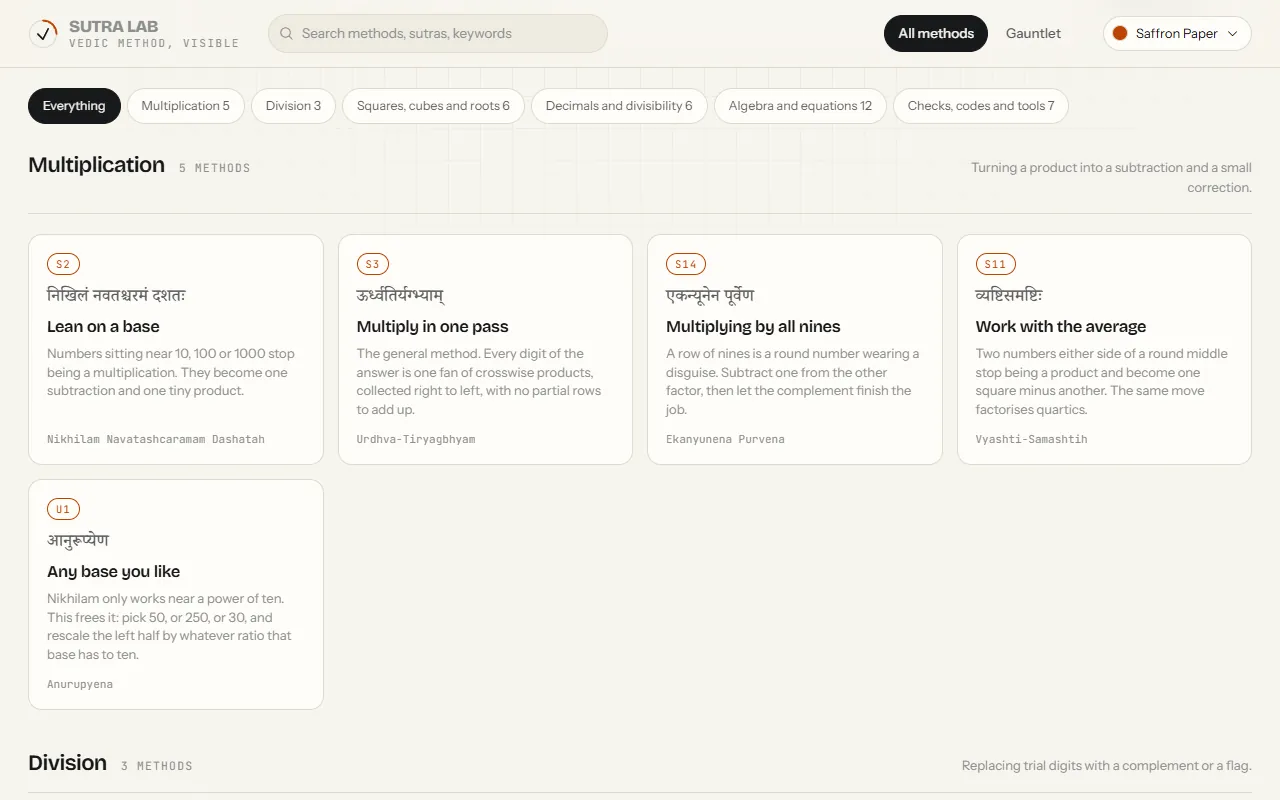
Same calculation, changing palette
One instrument, ten skins
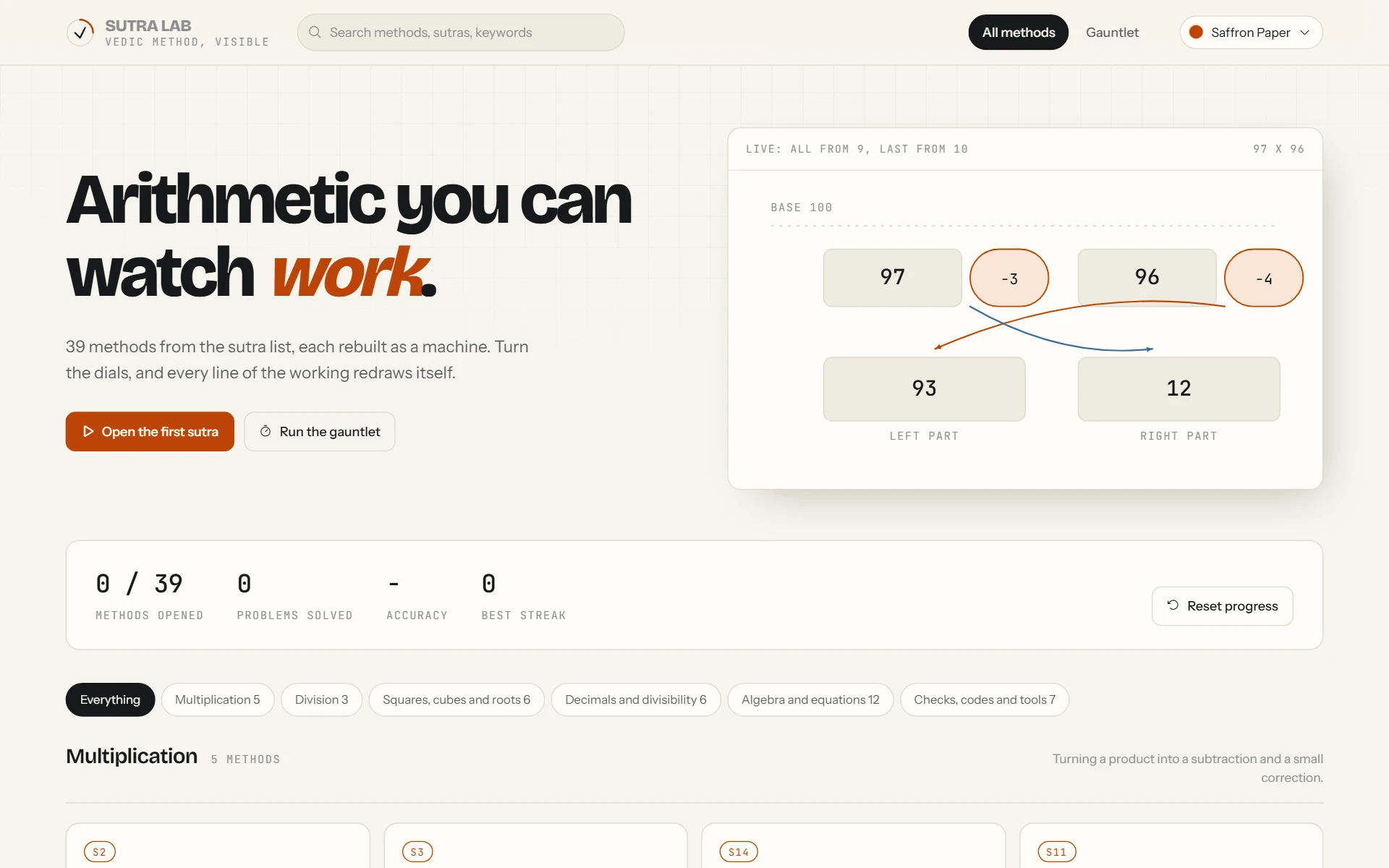
Saffron PaperThe theme changes the palette only. Numbers, steps and drawing stay identical, and the choice is remembered per reader.
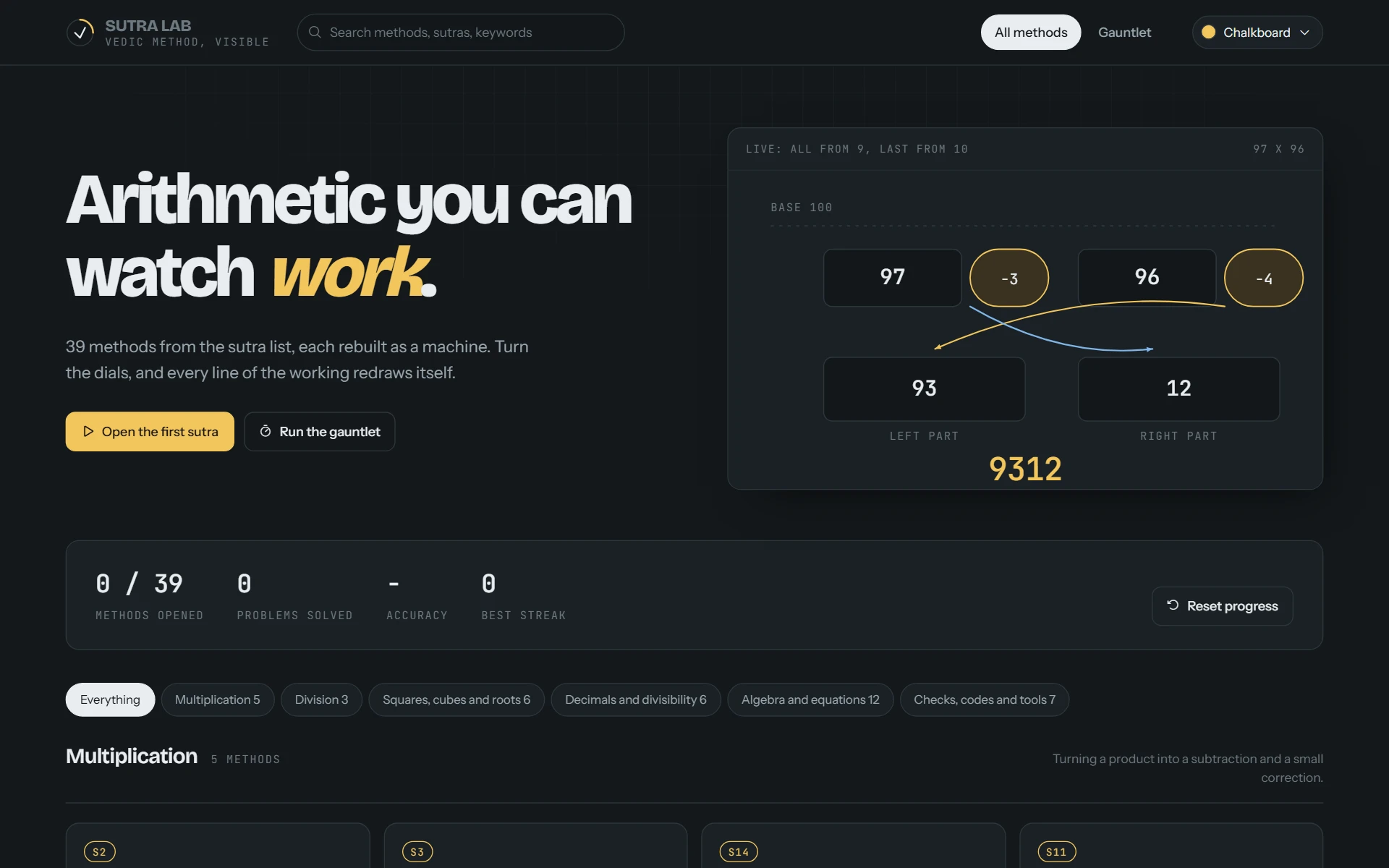
ChalkboardThe same calculation, set dark. Contrast stays above the readability line in every one of the ten themes.
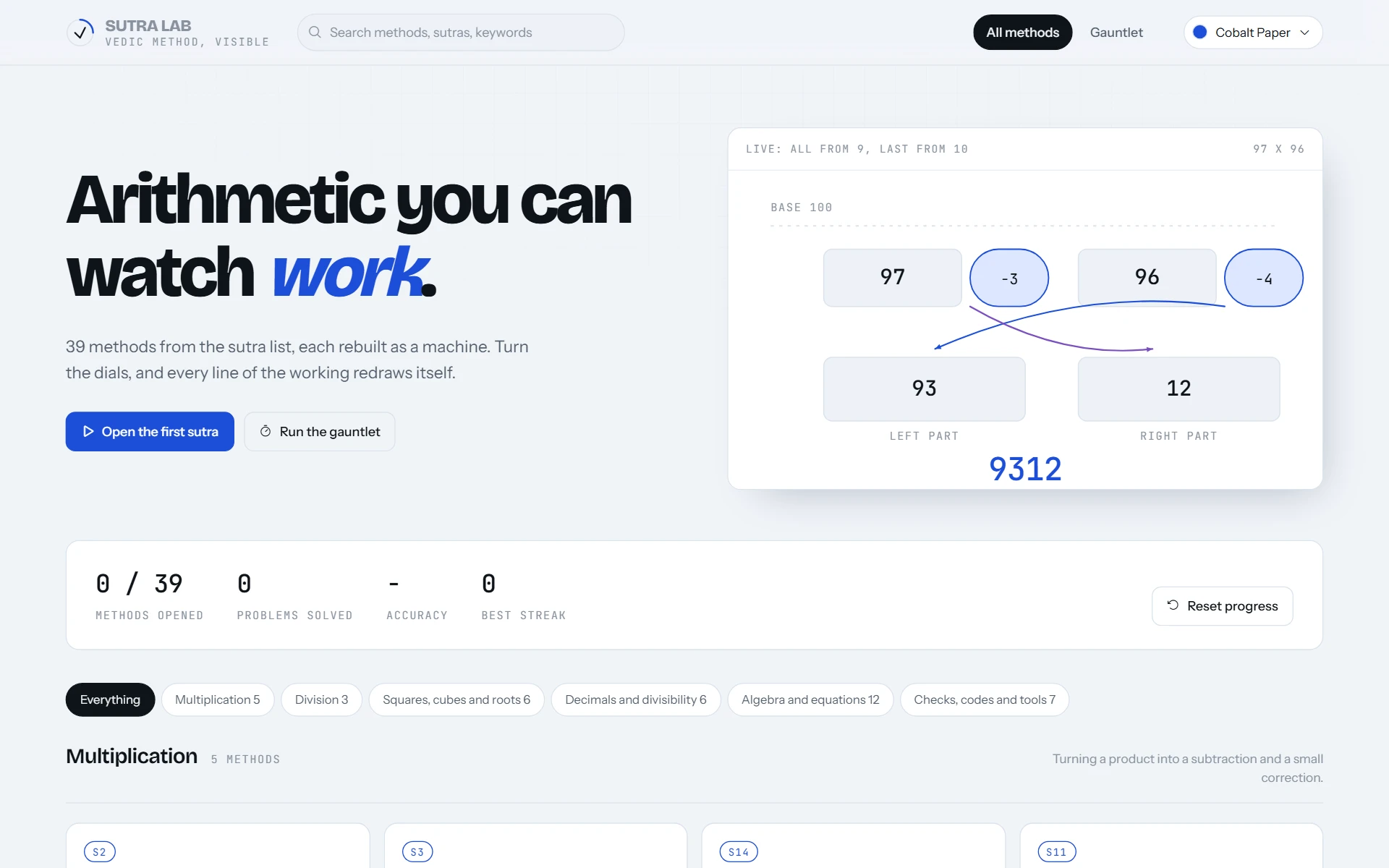
Cobalt PaperFor handouts and print: a high proportion of white, one strong accent, otherwise unchanged.
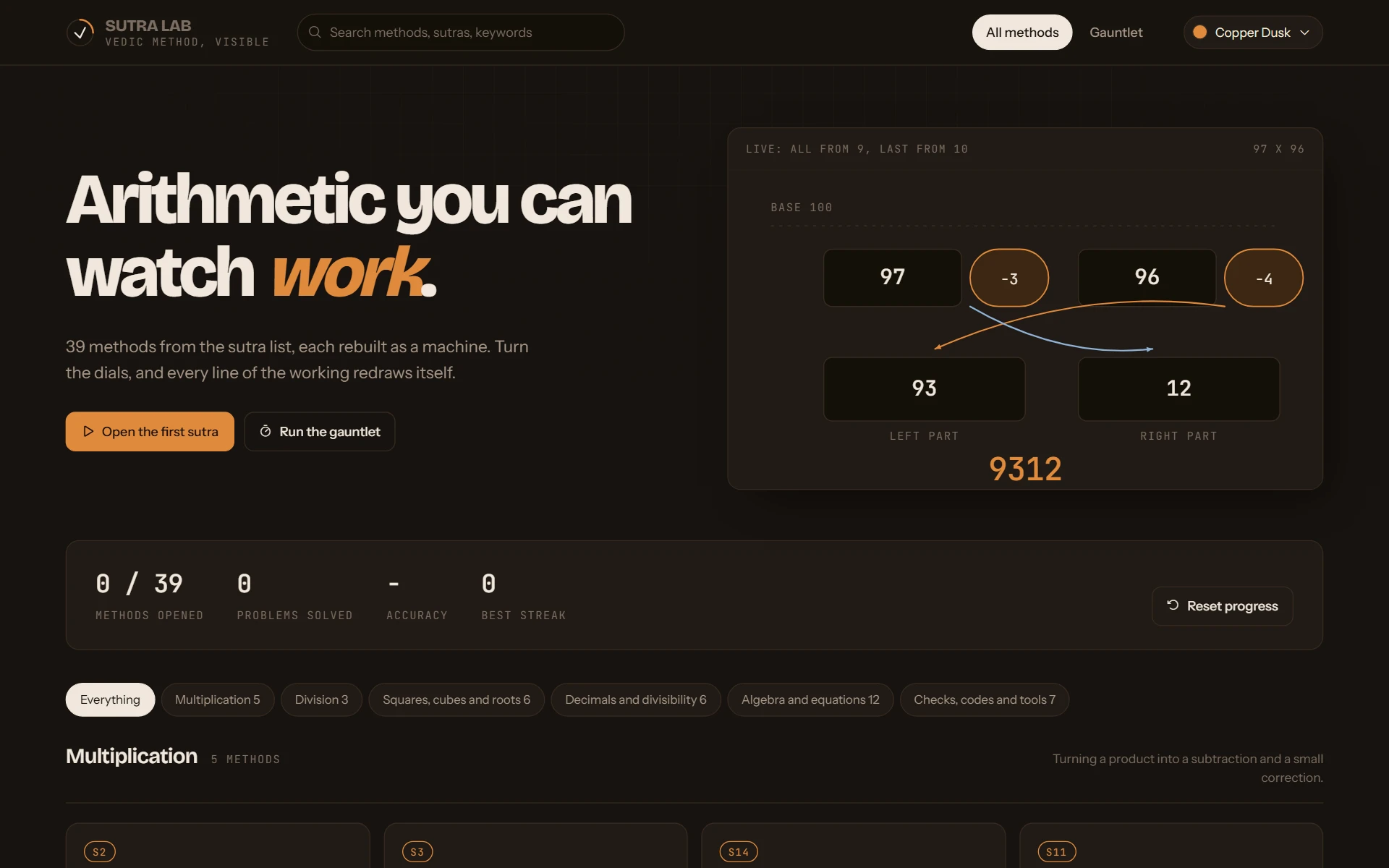
CopperTen themes, one switch at the top right. No theme changes a number, a limit or a step, only the colours.
Where it fits
- Test and calculation procedures that exist only as text and are therefore rarely followed through.
- Training on a method where the participants are meant to change the inputs themselves.
- Product logic with special cases whose limits have to be visible rather than footnoted.
- Documentation that has to carry the route to the result as well as the result.
- Subjects with a contested origin, where the presentation must not overstate what the sources support.
Image credits: every capture is a screenshot of our own applications. The Sanskrit aphorisms shown, the work title Vedic Mathematics (Bharati Krishna Tirtha, Motilal Banarsidass, 1965) and the names of the scholars cited come from the project's source material. There is no connection to the rights holders or to the people named.
“The rules are correct, some are excellent, and teaching them as mental-calculation technique is entirely defensible. What is not defensible is the historical claim.”
Why this is published
What this means for your project
More from the lab
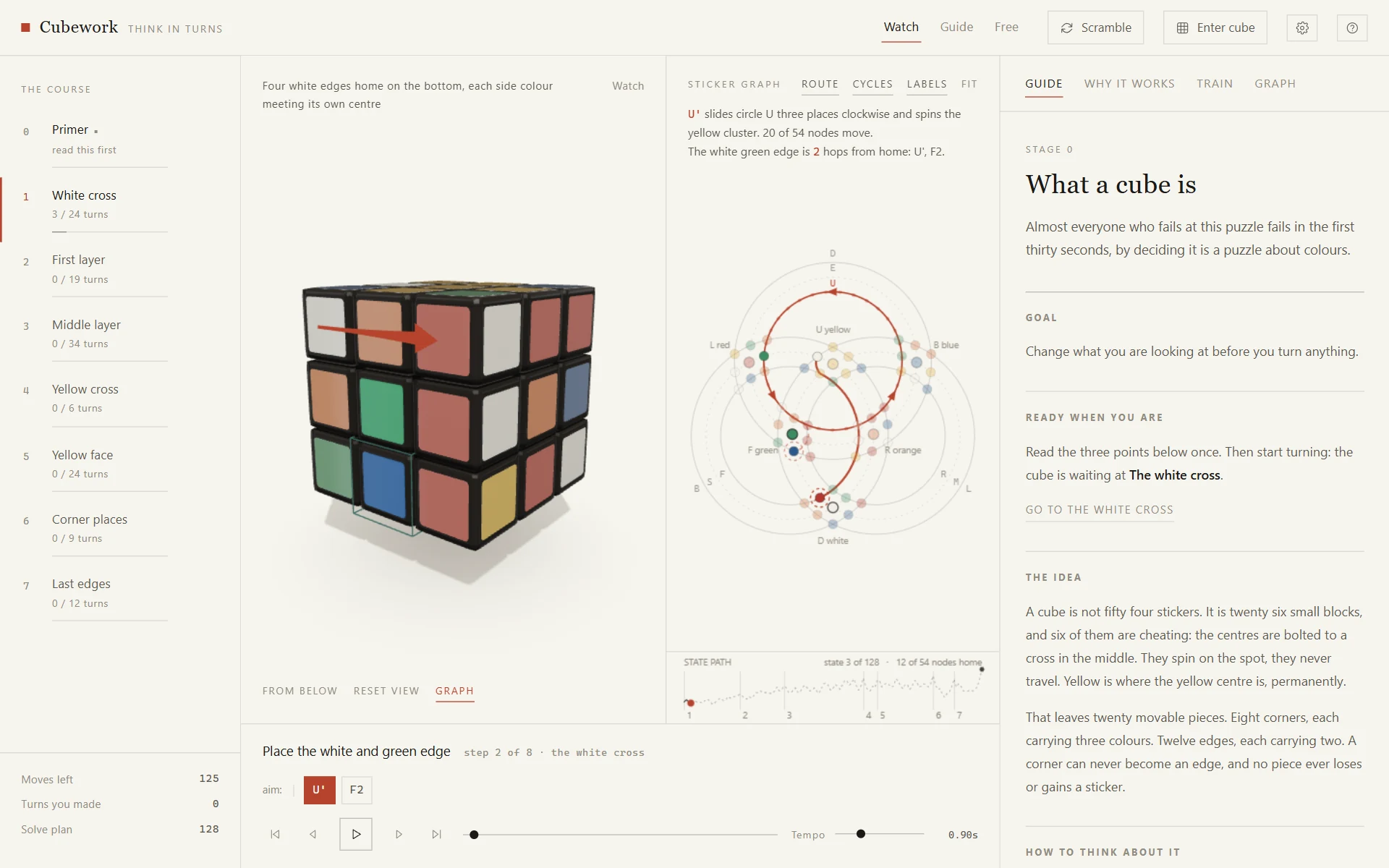
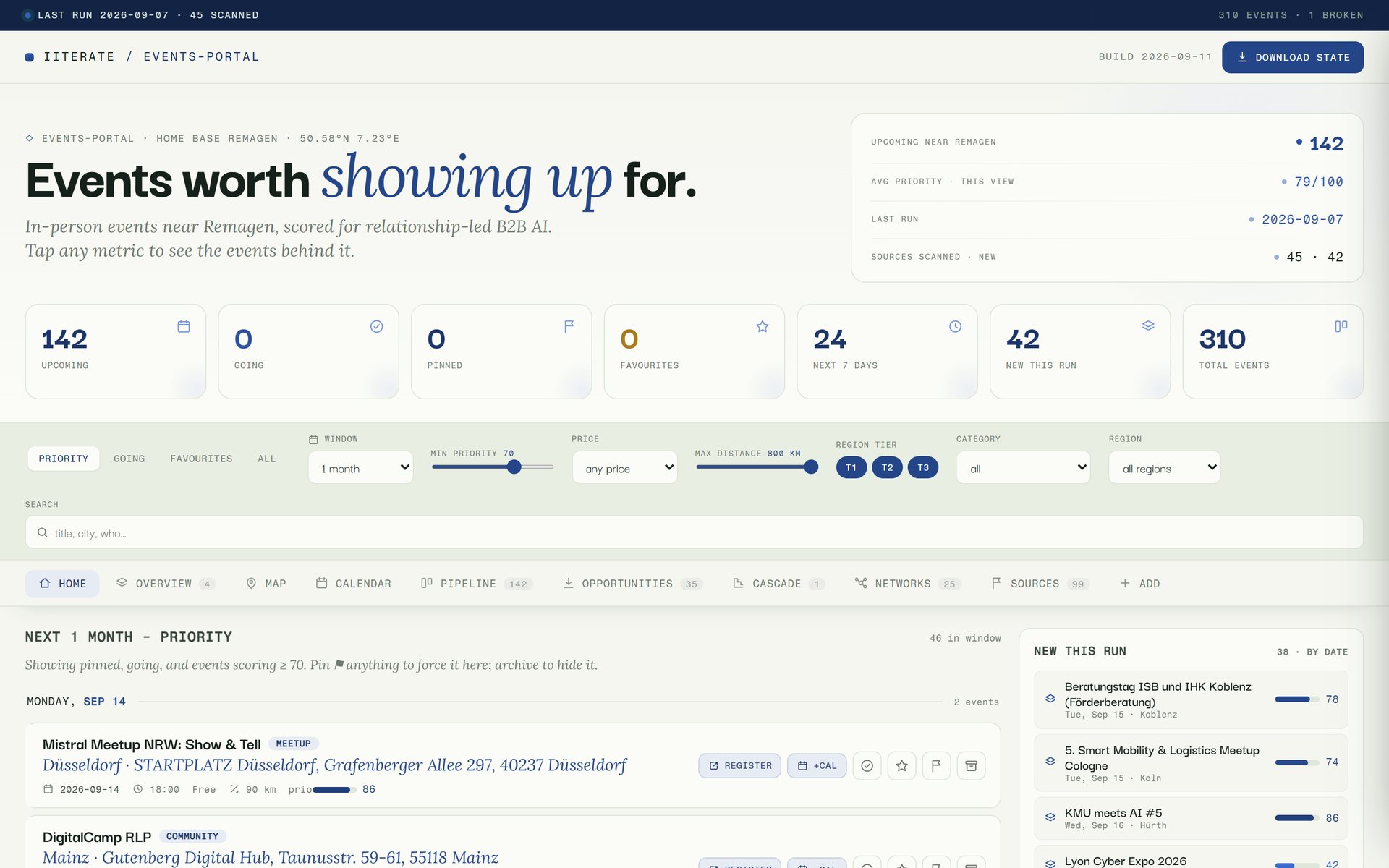 Method Event Scout A language model reads the event pages; everything else is fixed code. What remains is a short list of where a day in person is worth it.
  Applied Research Vellum Edges, perspective, light and text are all worked out on the phone. A document leaves the device only when someone sends it.
 Do you have a rule system that exists only as a document? It can be turned into an instrument someone can operate.
Get in touch