

PROJECT3D Design
Inside the Line
A complete cement line, built to scale out of dimensions and made walkable in twelve stations, from the quarry face to the loaded truck.
12
stations, quarry face to truck
3
languages, interface and narration
1
file, offline on a double click
A plant you can walk through
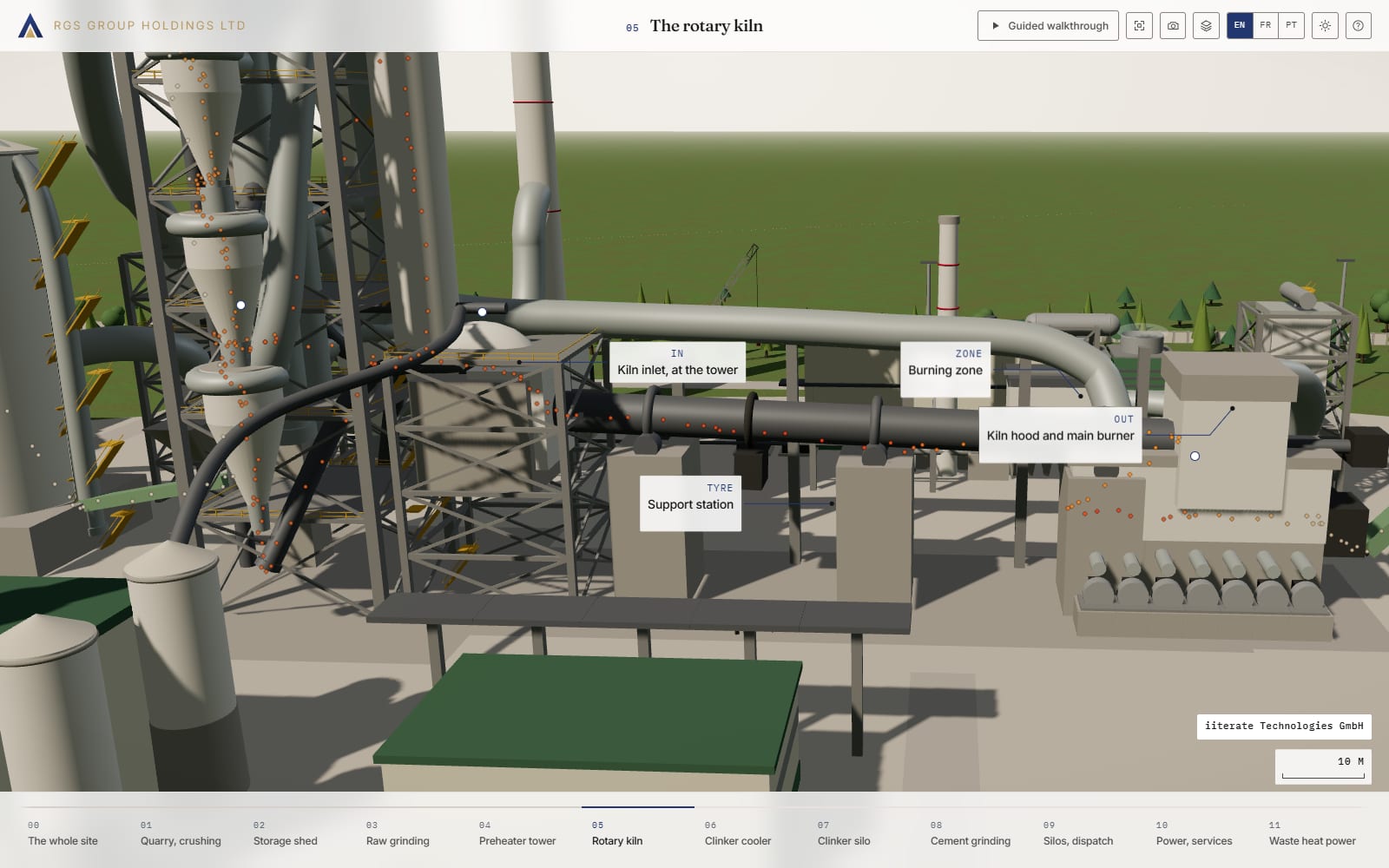
A cement plant is a single machine about a kilometre long, and almost nobody who decides about one has ever seen it from the inside. The usual substitute is a plant film: a camera move with music, after which you have seen a lot and kept nothing, because nothing is named and nothing stands still.
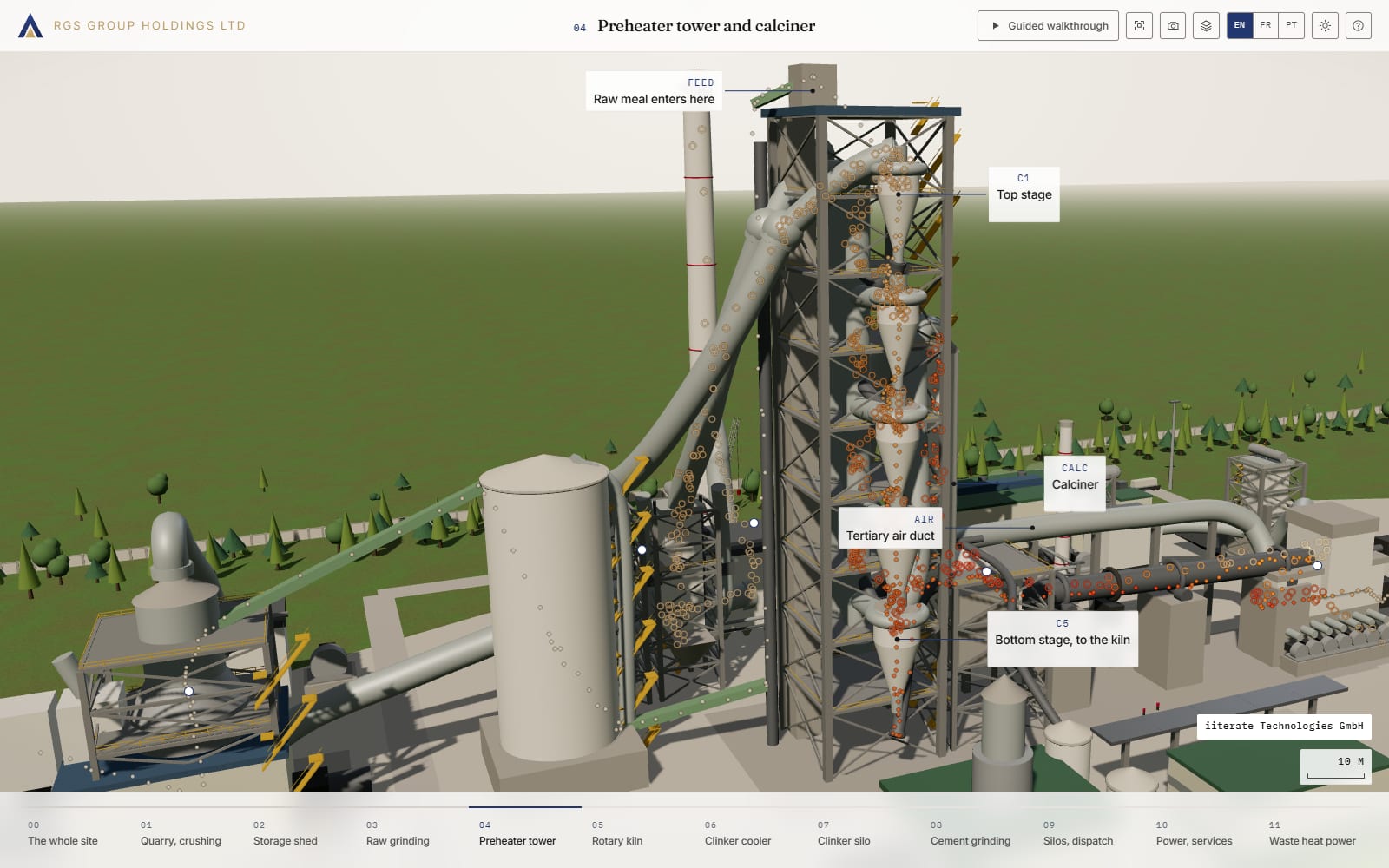
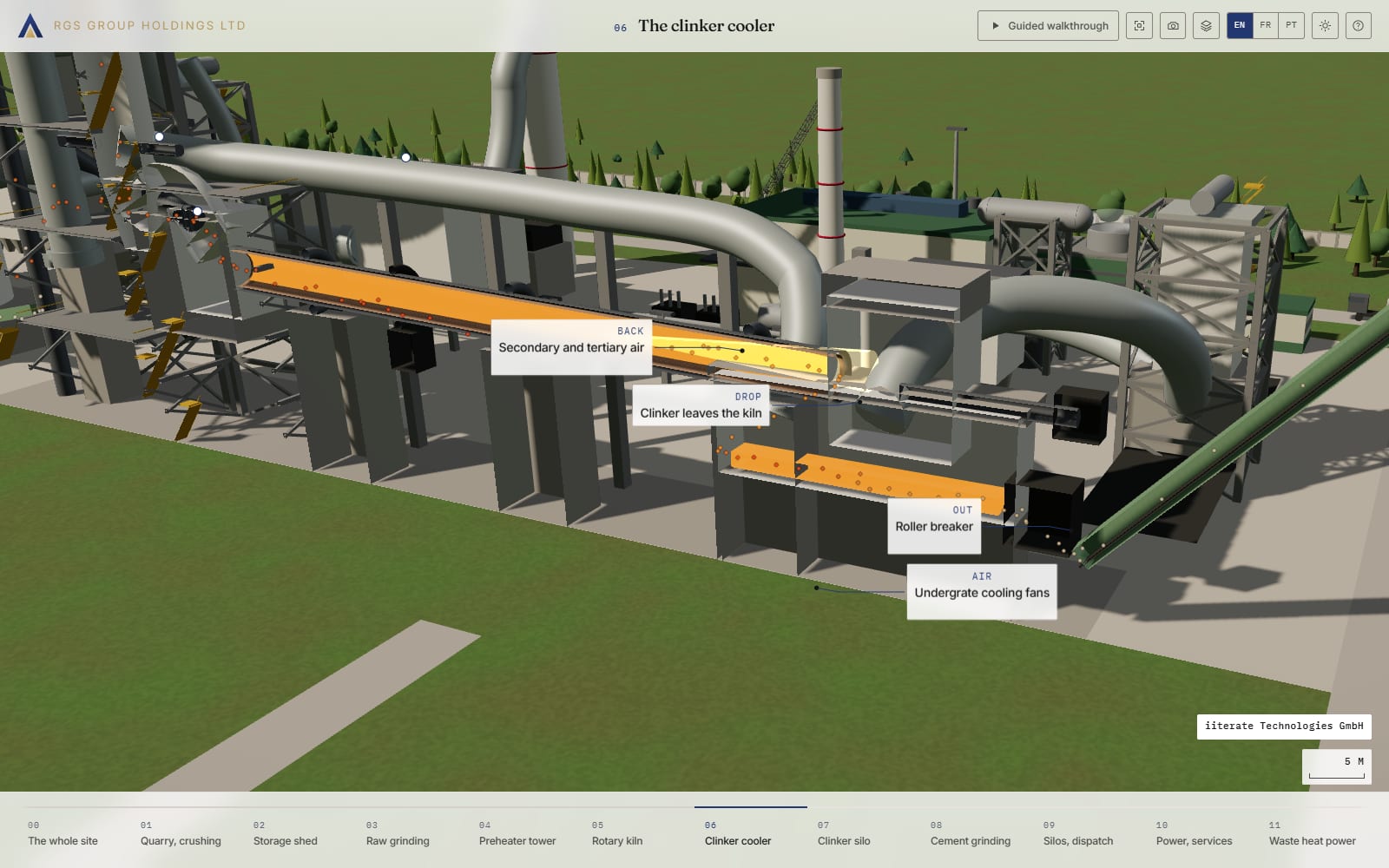
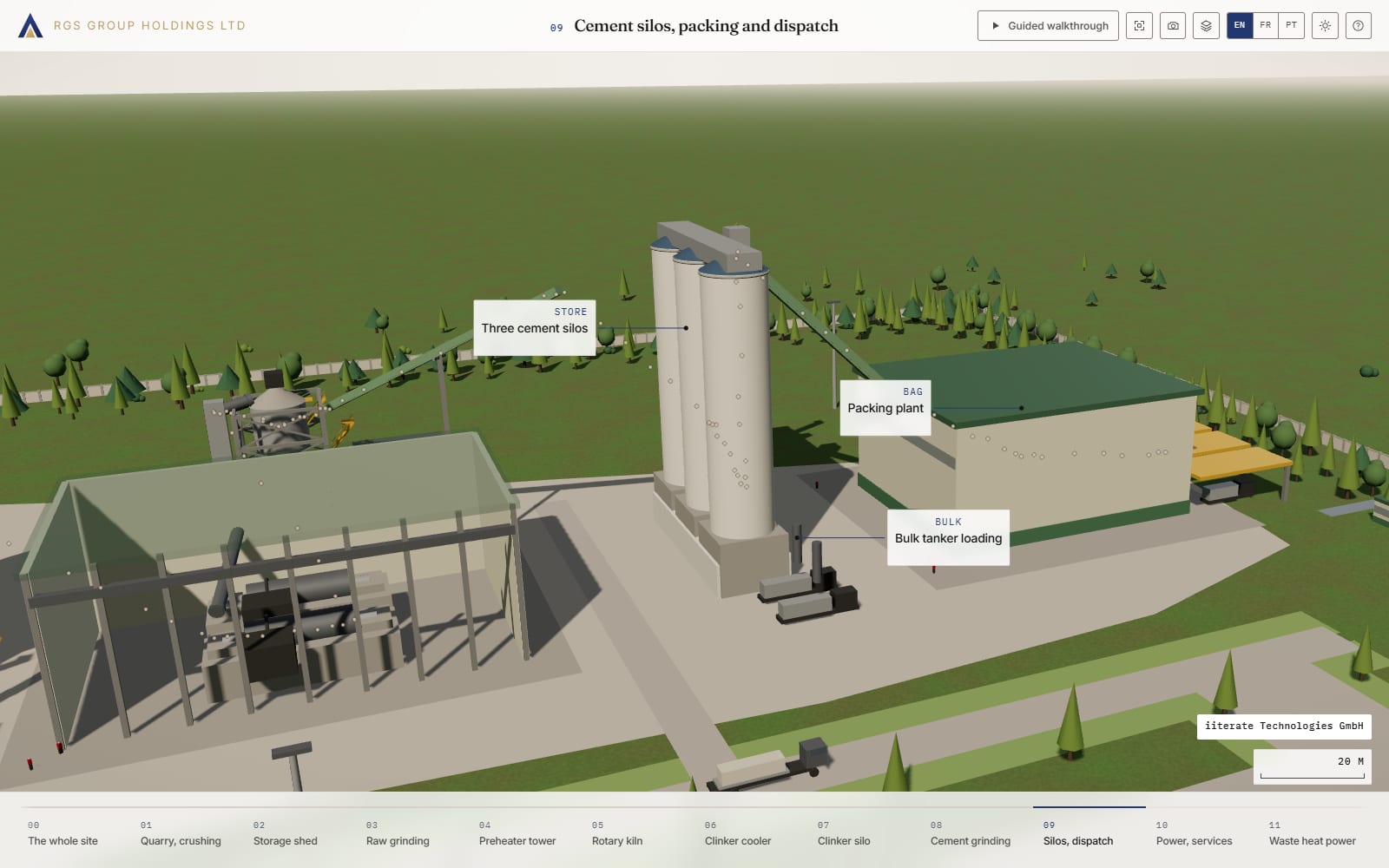
Inside the Line is the counter proposal. The visitor lands on a complete line, drawn to scale, and walks it in twelve stations: the whole site from the air, quarry and crushing plant, the covered raw material store, raw mill and meal silo, preheater tower with calciner, rotary kiln, clinker cooler, clinker store, cement grinding, silos with packing and dispatch, gas handling and power, and last the waste heat recovery plant that catches the heat the kiln has finished with and turns it into part of the works supply.
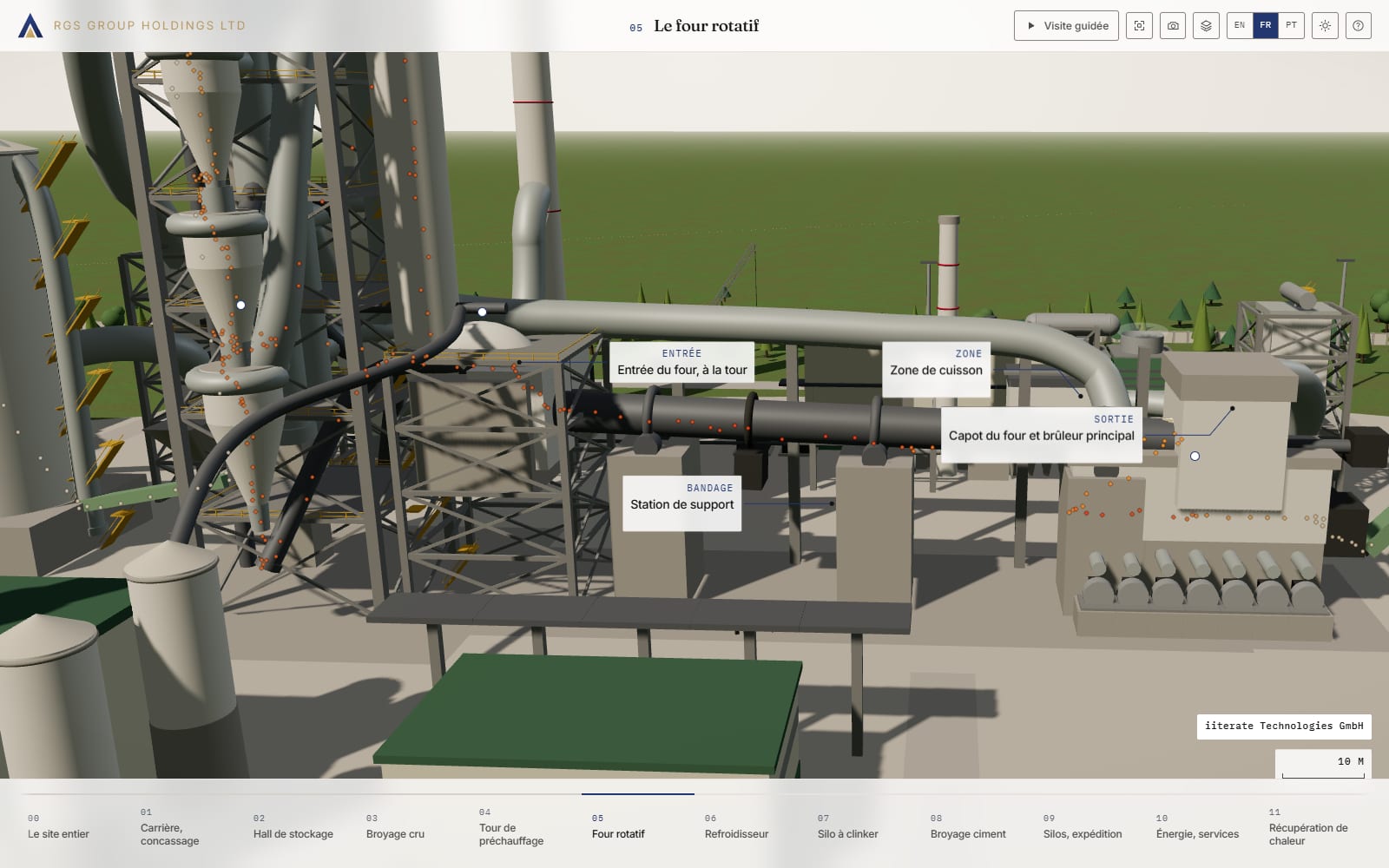
Every station moves the camera into a composition, drops annotated callouts onto the real points of the machine, and writes beside it what stands there, what it does, in what order it is commissioned and what the package covers at that point. It is not a showreel, it is a walk you come out of with names for things.
Built for RGS Group Holdings.
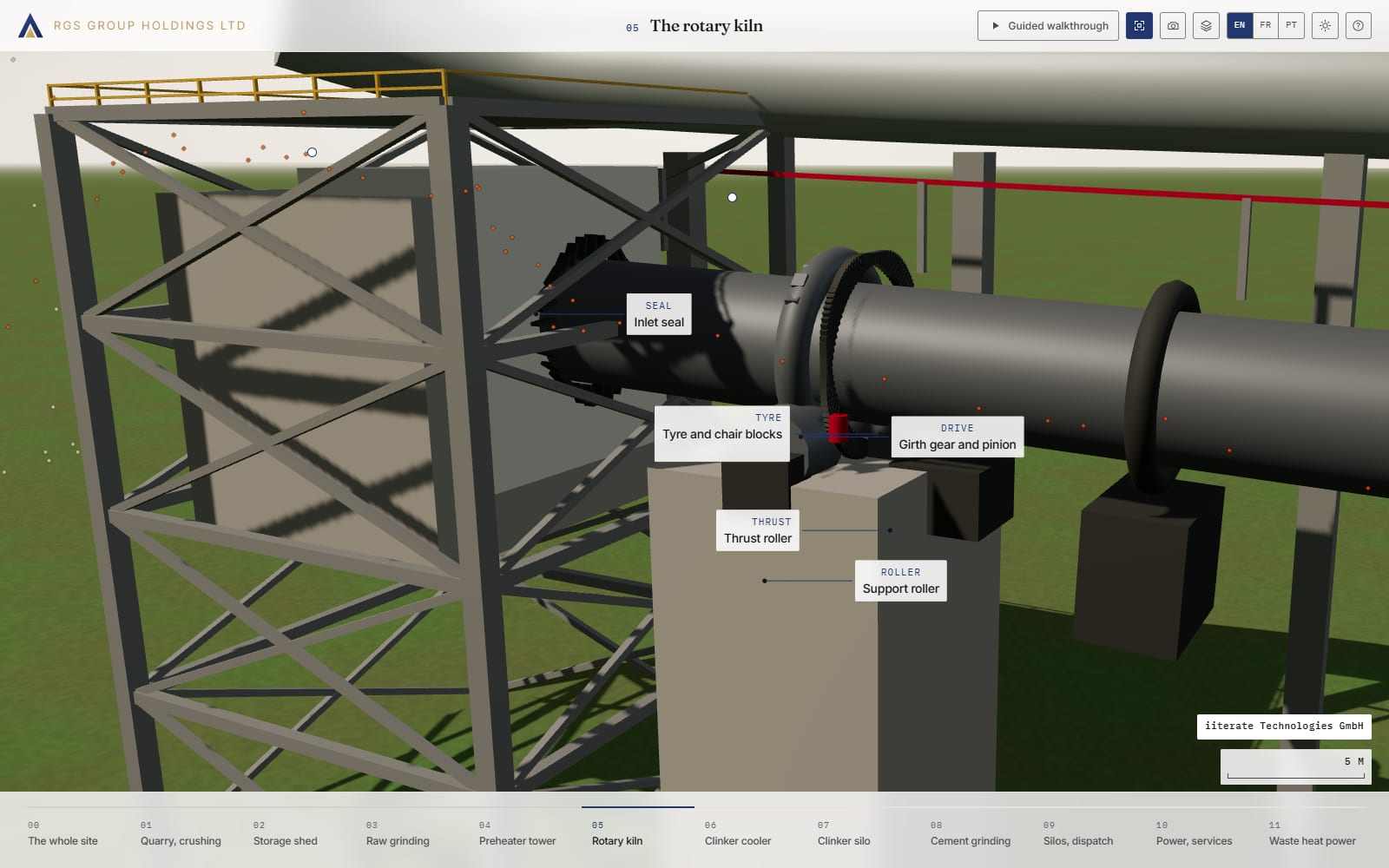
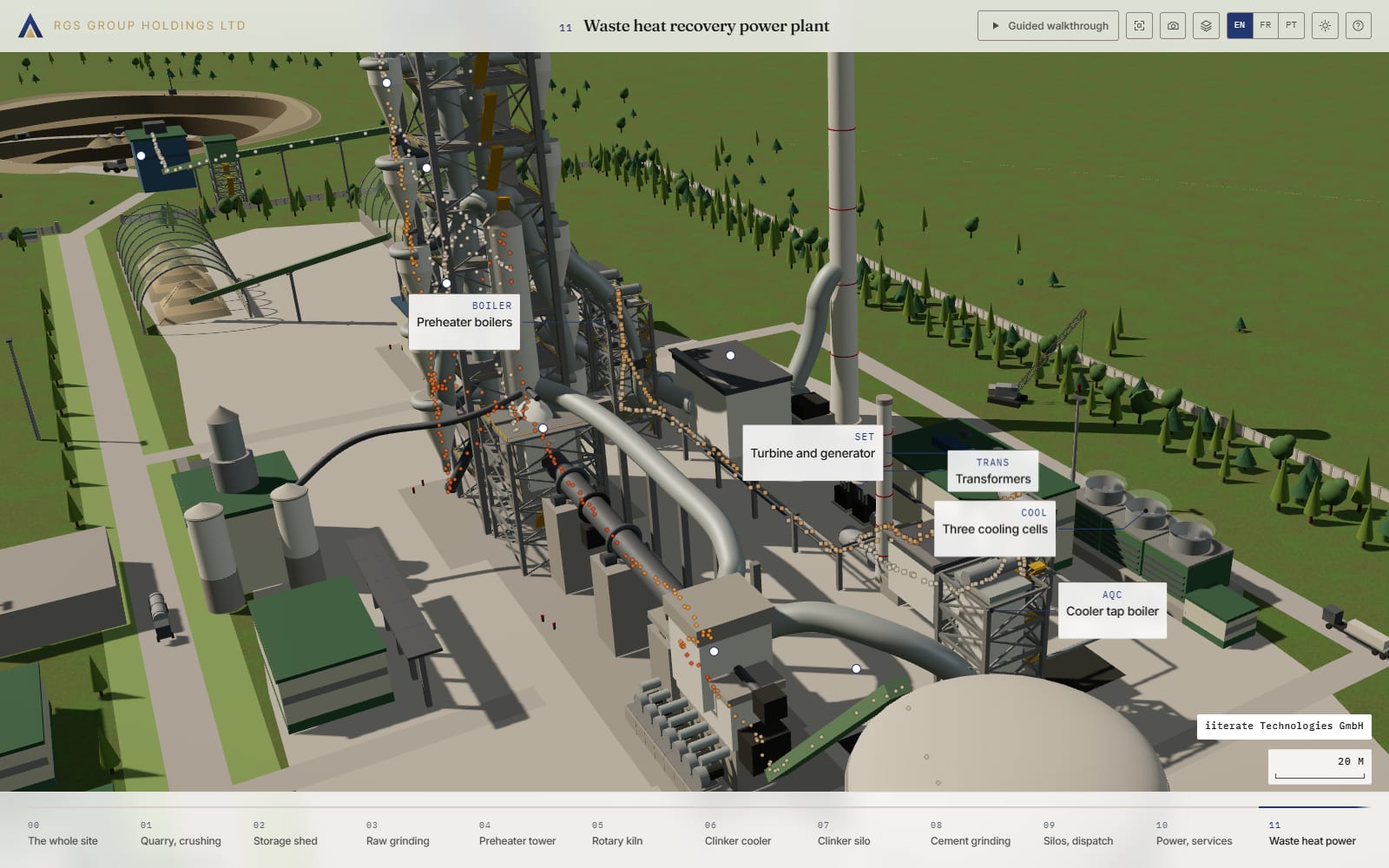
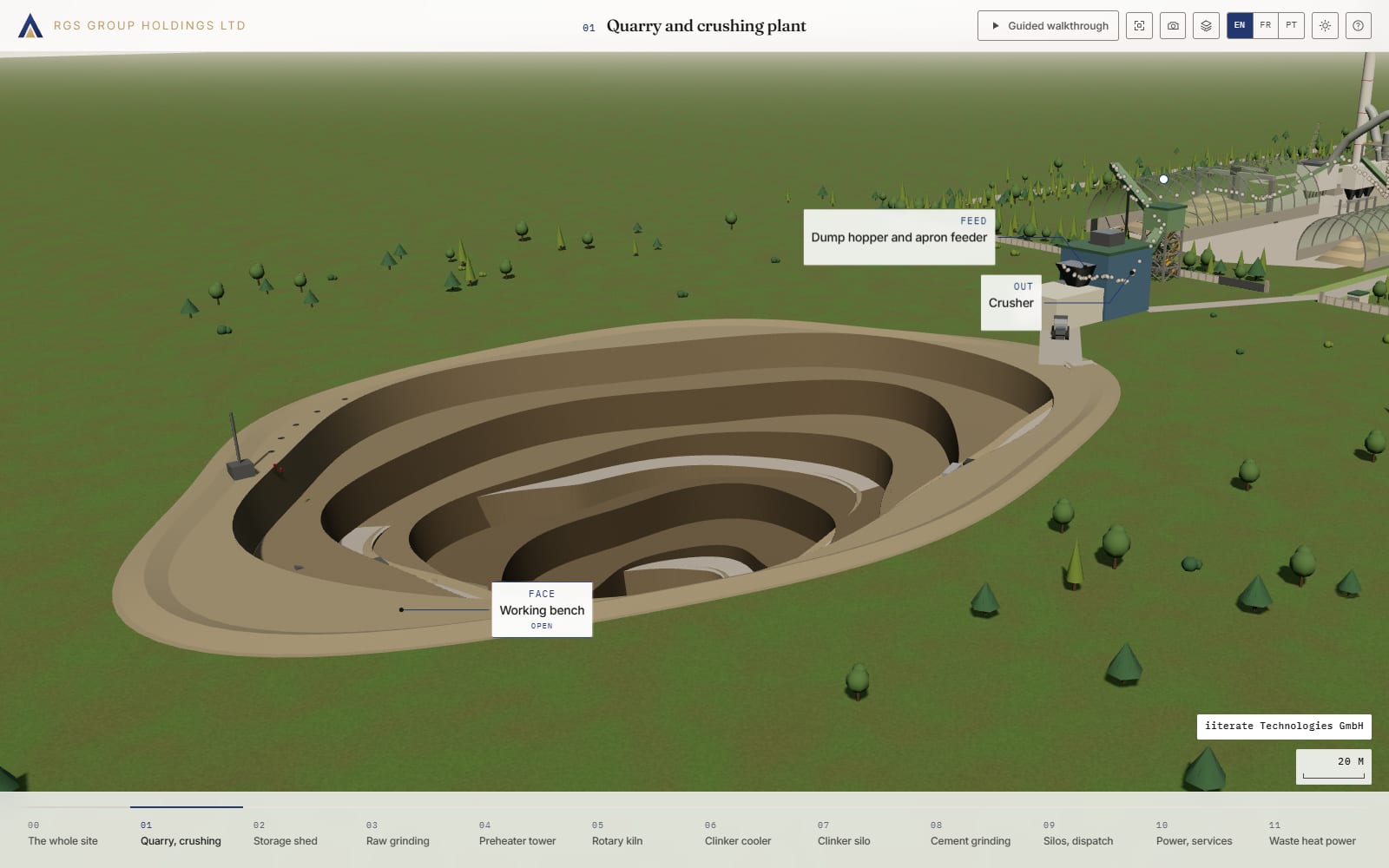
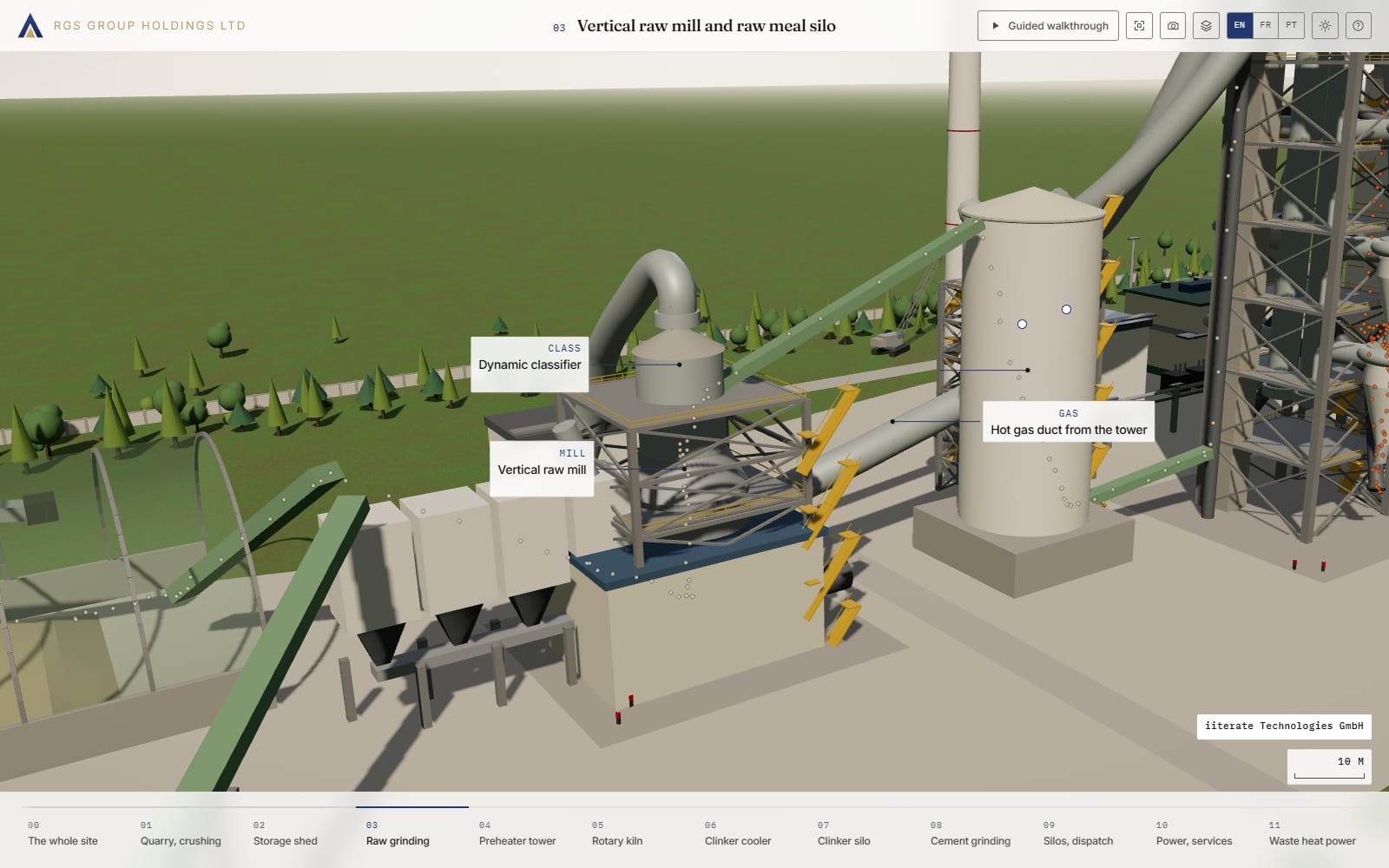
One file owns every dimension
The site is not modelled, it is calculated. Kiln length and slope, tower height and cyclone radii, mill diameters, silo diameters, conveyor routes, road centrelines, bench widths in the quarry: all of it exists exactly once, in metres, in a single file.
The geometry reads from it, the twelve station cameras read from it, the anchor points of the callouts read from it, the section planes read from it and the three particle streams read from it. A machine therefore cannot move without its label, its camera and its material stream moving with it.
This is not tidiness, it is the class of defect that disappears with it. An imported model and a figure written beside it drift apart eventually, and nobody sees it, because both stay plausible on their own. A check run therefore recomputes every printed figure out of the geometry and the gas balance and sets it against what the text says. If the two disagree, the run stops before anyone sees the page.
The two counter flows
Two streams run the full length of the works in opposite directions. Solids travel east, gas travels west. Raw meal falls down the preheater tower while kiln exhaust climbs it, and that is why the gas gives its heat to the meal instead of losing it to the sky.
That is exactly why a modern kiln needs a fraction of the fuel its predecessor did, and it is also the sentence an audience most reliably forgets again. A switch fades the works to an x ray and runs both streams at once. It is the one claim in the piece that a still image cannot make.
The streams are not decoration. They follow the same path curves the direction arrows are cut from, and those curves read their control points out of the same dimension file as the plant. At the waste heat recovery plant a third circuit joins them: feedwater, steam and condensate running between the boilers on the tower and the cooler, the turbine and the cooling cells.
Five readings of the same geometry
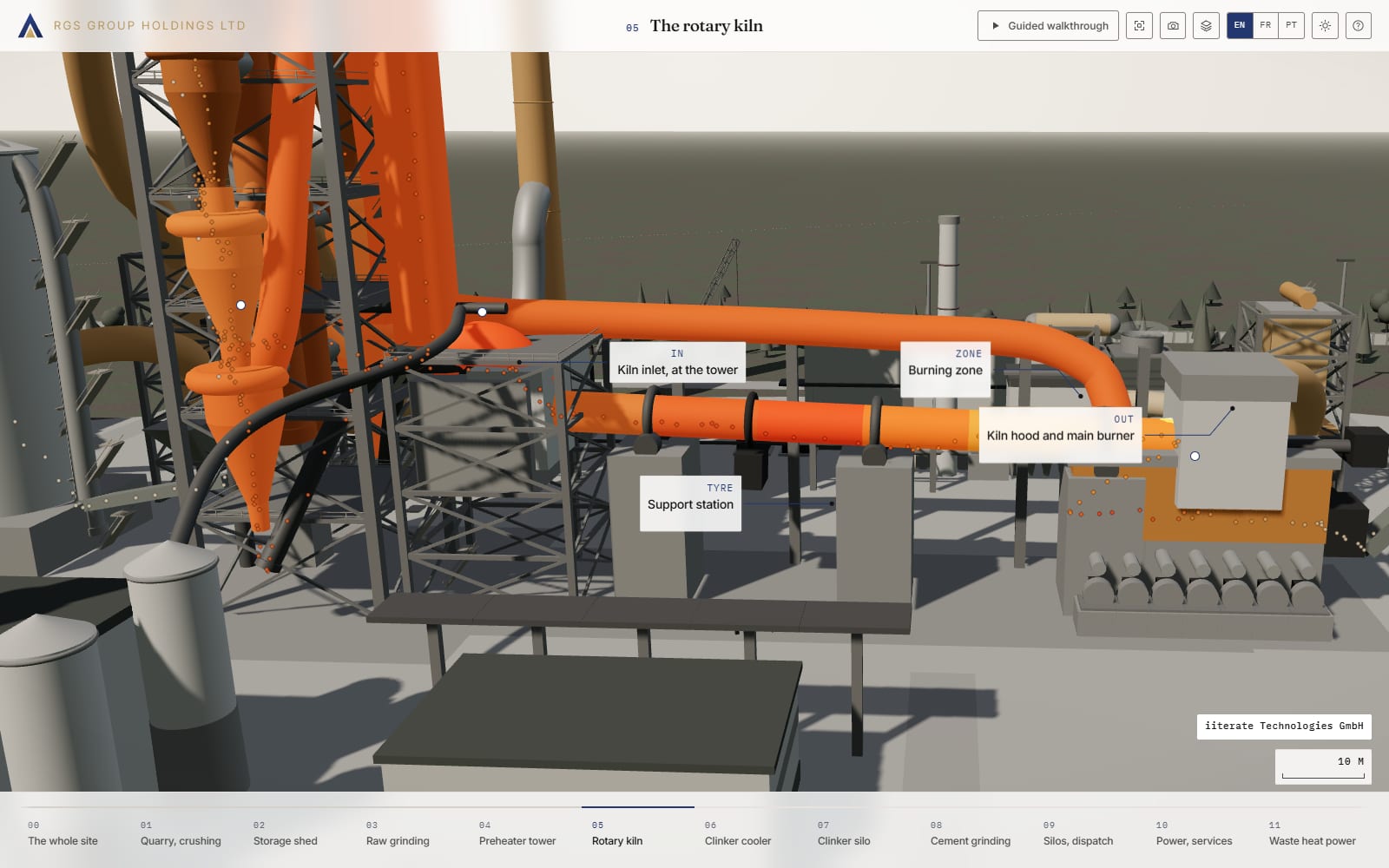
Layers sit over the model, not variants. Material flow, gas path and steam circuit show what runs where. Thermal colours the same geometry by material temperature, from cold up into the sintering range, so it is immediately visible where the line is hot and where heat leaves the works. Cutaway opens a machine along a plane each station brings with it, on the axis of whatever it is explaining.
Isolate goes furthest: the rest of the works disappears, close range geometry is built on demand, and a denser set of callouts appears. At the kiln those are the tyre, the support rollers, the thrust roller, the girth gear and the inlet seal, which is exactly the set of parts a maintenance discussion is actually about.
None of these layers is a second model. All of them colour, section or hide the same geometry, which is why they cannot contradict each other and can be combined freely.
It performs itself
An interactive piece is no use to somebody standing in a room who has to talk. So there is a guided walkthrough: a timeline of beats, each with one thing to say and one thing to show, with a transport, chapter marks and a presentation view that hides the notes panel and the station rail.
It opens on a title card that stands alone first and reveals the site from underneath it. Before that, everything arrived at once, wide shot, seven callouts, chapter card and transport inside the same second, and nothing led. Now the clock is already running while the card still stands, so the camera is in motion by the time it lifts.
There are two cuts. The short one runs a little over five minutes, one station per beat, and starts by itself as soon as you enter the works. The long one reads every station out in full. Turning the model during a run does not stop it: the hand movement is added as an offset on top of the choreographed camera and dissolves again on its own afterwards.
The narration is not written twice. It is the station text, which is why it cannot diverge from the panel beside it and why translating the piece translates the performance with it. Every beat carries a stable key that is also the filename of its recording, and a beat boundary waits as long as a recorded sentence is still being spoken. The running subtitle can be switched off and is off by default: spoken and read at once is once too often.
Three languages, one model, no connection required
The language is chosen on the loading screen, before the plant is built, because a switch you only find after entering arrives three English screens too late for a Portuguese reader. Interface, station texts, detail sheets, walkthroughs and narration change together.
Language does not touch the model. The translation lies over the records and replaces prose only, while geometry, cameras, anchors and section planes exist exactly once. Figures are not translated but formatted locally as they are drawn, so a decimal point never turns into a thousands separator. A fourth language is therefore a text file and not a second plant.
And the whole thing packs into a single document: script, styles, fonts, photographs and audio as embedded data. A double click, no server, no installation, no network. A talk that assumes reliable wifi is not a talk, it is a risk.
Callouts that are true, and sliders that cost something
Callouts in a 3D scene are where most such pieces fall apart. They overlap, they jump from one side to the other as you turn, they jitter, and the point they name ends up a few pixels off the machine. Here that is four separate mechanisms: a side choice with hysteresis, a bundled stacking order, a symmetric push apart on collision and a damped trailing of the box. The point itself is never smoothed, because it is the place on the machine and has to be right. Two separate checks turn the model and measure: one for how far a callout travels, the other for whether its leader line touches the box at all. A box and a line can move together perfectly and never meet.
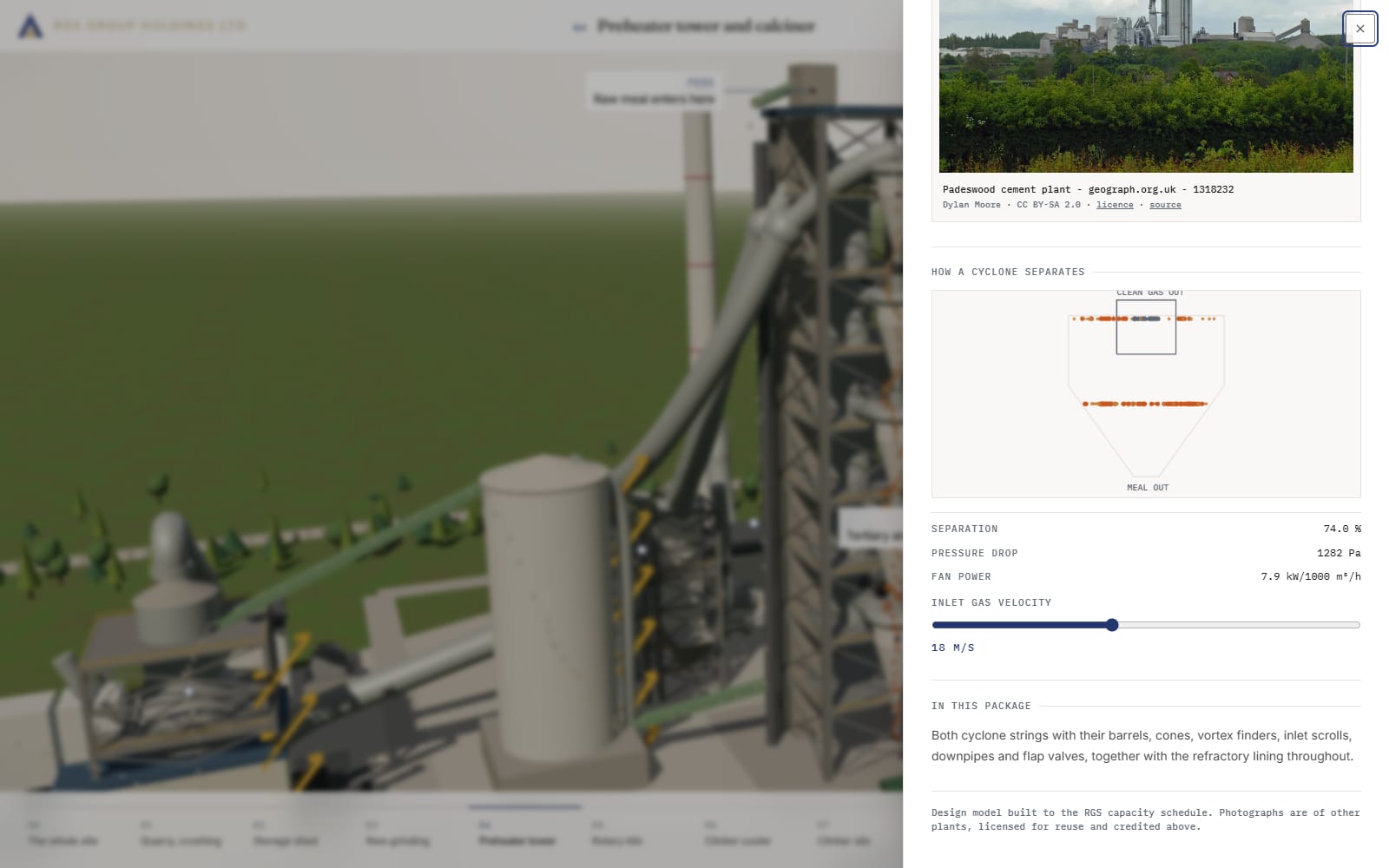
Clicking a callout opens a detail sheet: longer text on what stands at that point, a licensed photograph of one built elsewhere so the scale can be read against something real, and underneath it what the package covers at exactly that point. Where a mechanism has a trade off worth feeling, a small interactive demonstration of it stands there too. There are five, each with the one slider an operator really has. At the top cyclone that is the inlet velocity: more separation costs pressure drop, and pressure drop costs fan power. Both run along while you drag.
Image credit: the photographs shown in the detail sheets come from Wikimedia Commons and geograph.org.uk under CC BY-SA, CC0 or public domain. Author and licence stand at each image.
Frequently asked questions
Inside the Line is an interactive 3D presentation of a complete cement line, built to scale from dimensions and walkable in twelve stations, from the quarry face to the loaded truck. Each station frames the camera, places annotated callouts on the real points of the machine and explains what stands there and what it does.
Inside the Line runs without a connection: the whole application can be packed into a single document, with script, styles, fonts, photographs and audio as embedded data. A double click is enough, with no server, no installation and no network, so a presentation does not depend on reliable wifi.
Inside the Line is built on three.js, WebGL, Vite, Web Audio and Playwright. Every dimension of the plant exists exactly once, in metres, in a single file that geometry, station cameras, callouts, section planes and particle streams all read from. A check recomputes every displayed figure from the geometry and compares it with the text.
Inside the Line is available in three languages, each covering interface and narration. The language is chosen on the loading screen. Only the text is translated, while geometry and cameras exist once. The guided walkthrough comes as a short cut of a little over five minutes and a long cut that reads every station in full.





Get to know more
HAVE A COMPLEX IDEA THAT YOU WOULD LIKE US TO IMPLEMENT?
KICK OFF WITH A DESIGN-THINKING PILOT OR A CONSULTING CALL.