The state of AI development in Rhineland-Palatinate
Rhineland-Palatinate researches AI at the national level. Reaching the Mittelstand still has to happen.
This translation was produced automatically using AI. The German version is the editorially reviewed original.
Rhineland-Palatinate's AI strength today lies in research, not in reach. Kaiserslautern, with the DFKI and RPTU, is an AI cluster at national level, Koblenz is building a second hub, and the state itself is betting early on sovereign, local AI. But between that peak and the workbench in the Mittelstand there is a gap. Whoever talks about AI in RLP is really talking about two speeds.
This piece places both in context: what is already strong, where it stalls, and what follows from that for a company on the ground.
01. The research is there, and it is dense
Rhineland-Palatinate's research side does not need to hide behind any other federal state. It is simply heavily concentrated.
Kaiserslautern carries the core: the main site of the DFKI, the RPTU with eight AI professorships, Fraunhofer IESE and ITWM, plus a cooperation with the Max Planck Institute. Germany's first AI innovation and quality centre under Mission KI is also based here, with a federal budget of EUR 32 million. Koblenz is building the second pole: the university launched an interdisciplinary AI hub in July 2025, and Koblenz University of Applied Sciences runs DigiMit, a competence centre for the region.
The honest assessment sits right next to that. The cluster is weighted towards Kaiserslautern and Koblenz, the rural areas are less well connected, and in the national comparison RLP sits in the upper mid-field, not at the top. On digitalisation, Bavaria, Berlin and Hamburg lead, on innovation it is Baden-Württemberg.
02. The state itself is betting on sovereign AI
What is notable is what the state actually works with: not a US cloud subscription, but its own sovereign approach.
The state's AI agenda names an AI triad, and one of the three pillars is explicitly LLM on-premise. With GPU4GenAI, the state is investing in its own GPU infrastructure at the DFKI, and since September 2025 a three-year cooperation with the DFKI has been running that brings AI into state administration: document analysis, secure data platforms, assistance systems.
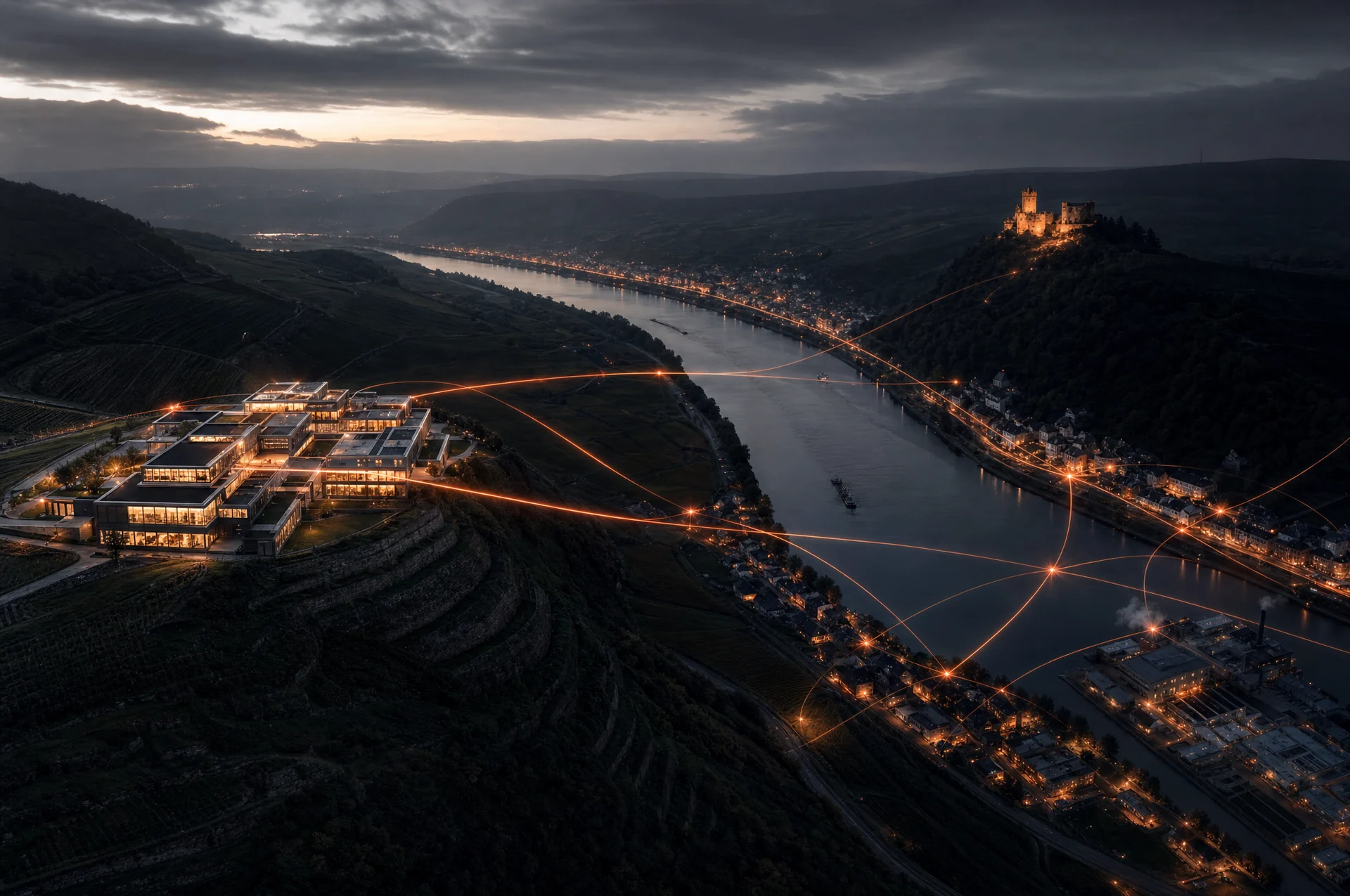
That is more than a footnote. If the public sector in RLP is building data-protection-compliant, locally operated AI, then on-prem and sovereignty consulting for the Mittelstand is not a niche topic, it is a natural extension of what the state is already demonstrating. The chart below shows the underlying problem: strong hubs, too few connections into the rural areas.
03. In the Mittelstand, the picture looks different
On the shop floor, the pace is different, and the numbers are sober.
In a survey by Koblenz University of Applied Sciences in northern RLP (176 companies, December 2025), only 8.5 percent rate AI as central to their business model today, rising to 42 percent in five years. More than a quarter already use AI tools, roughly half are testing them in pilot projects. A second regional study by the IHK and the Handwerkskammer Koblenz shows the real pattern: just under two thirds use AI, most of them for no more than two years, almost 90 percent rely on external software, and the biggest challenge named is legal certainty.
Cutting-edge research and broad diffusion are therefore two different things. One is present here, the other is not yet.
04. The gap is implementation, not technology
The obstacle in the Mittelstand is rarely the model. It is the path from idea to safe, productive deployment.
Nationwide, only around a third of companies have a fully worked-out AI strategy, and in RLP a lack of expertise is repeatedly cited as the brake. And the almost 90 percent that rely on external software are buying dependency along with it, often on US cloud services, in exactly the area where those same companies name legal certainty as their biggest concern. That is a contradiction you can see coming.
An honest qualification belongs here too: usage rates overstate maturity. Much of it is informal use of freely available tools, without strategy, without governance, without a clear data protection framework. In the Mittelstand, the question is no longer AI yes or no. It is sovereign and productive instead of informal and risky. What that means in practice, we have spelled out in the practical AI roadmap for the Mittelstand.
05. What this means for companies in RLP
The obvious strategy is the one the state is already running: capture the benefits without giving up data sovereignty.
The missing piece is not another tool, it is the layer between funding and research on one side and productive, sovereign deployment on the other. Concretely, that means: local or Germany-hosted models for sensitive data, RAG knowledge management on your own document base, and a sober path from use case selection through to pilot operation. We assess when local AI pays off against the cloud in on-prem vs. cloud LLM.
We at iiterate are based in Koblenz and Remagen, right in the middle of the state's second AI pole, and this diffusion layer is exactly our work: bringing strategy, build and compliance together, instead of leaving Mittelstand companies alone between a funding notice and the shop floor. The research in RLP is a given. The more interesting question is how quickly it reaches the rural areas, and who draws the lines to get it there.

 Funding for AI projects in 2026: programmes, requirements and the path to an application