PROJECTAI
Smart Grant AI
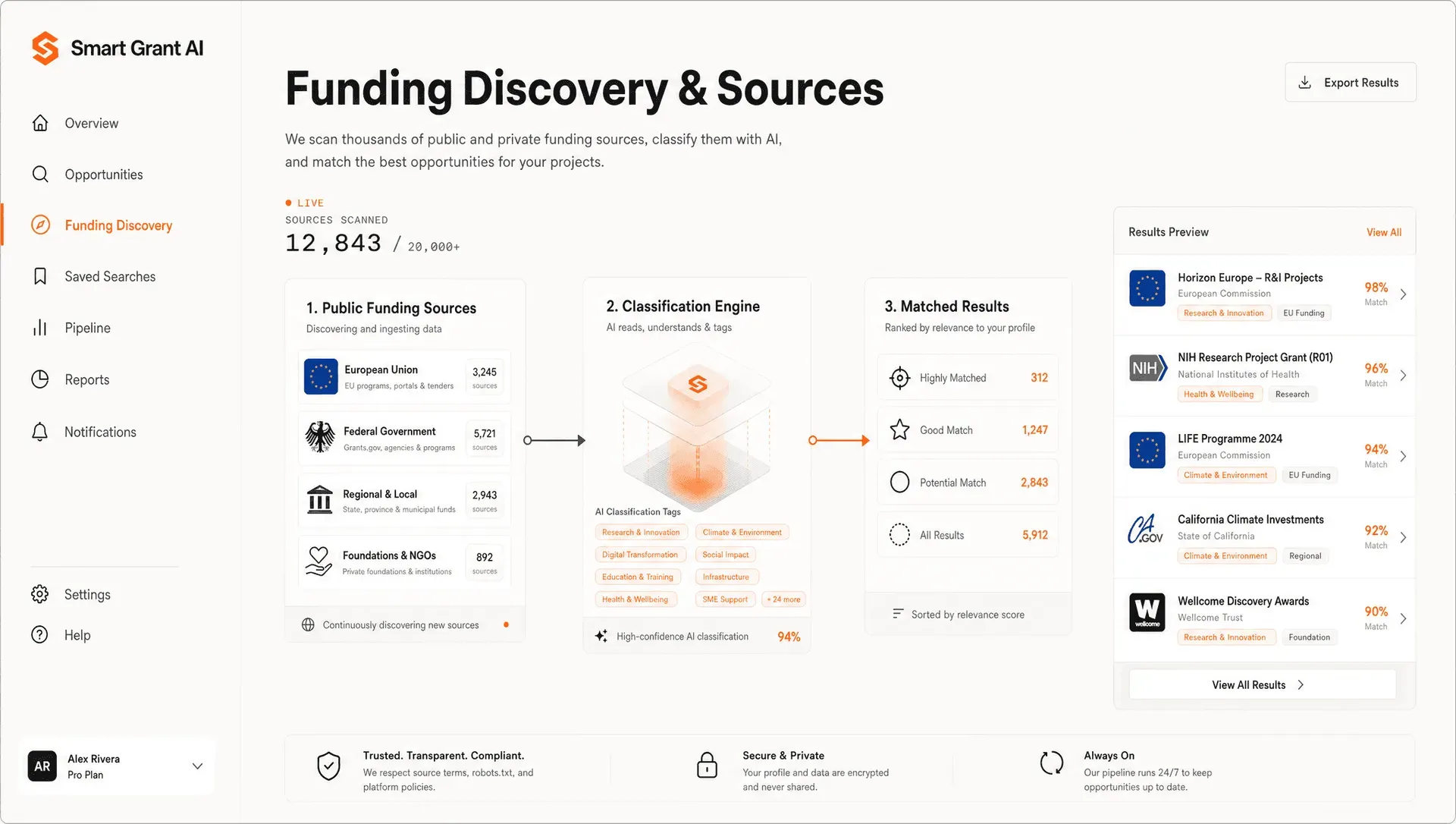
SmartGrant sims to automate discovery of public funding and grant opportunities in Germany.
Project Introduction
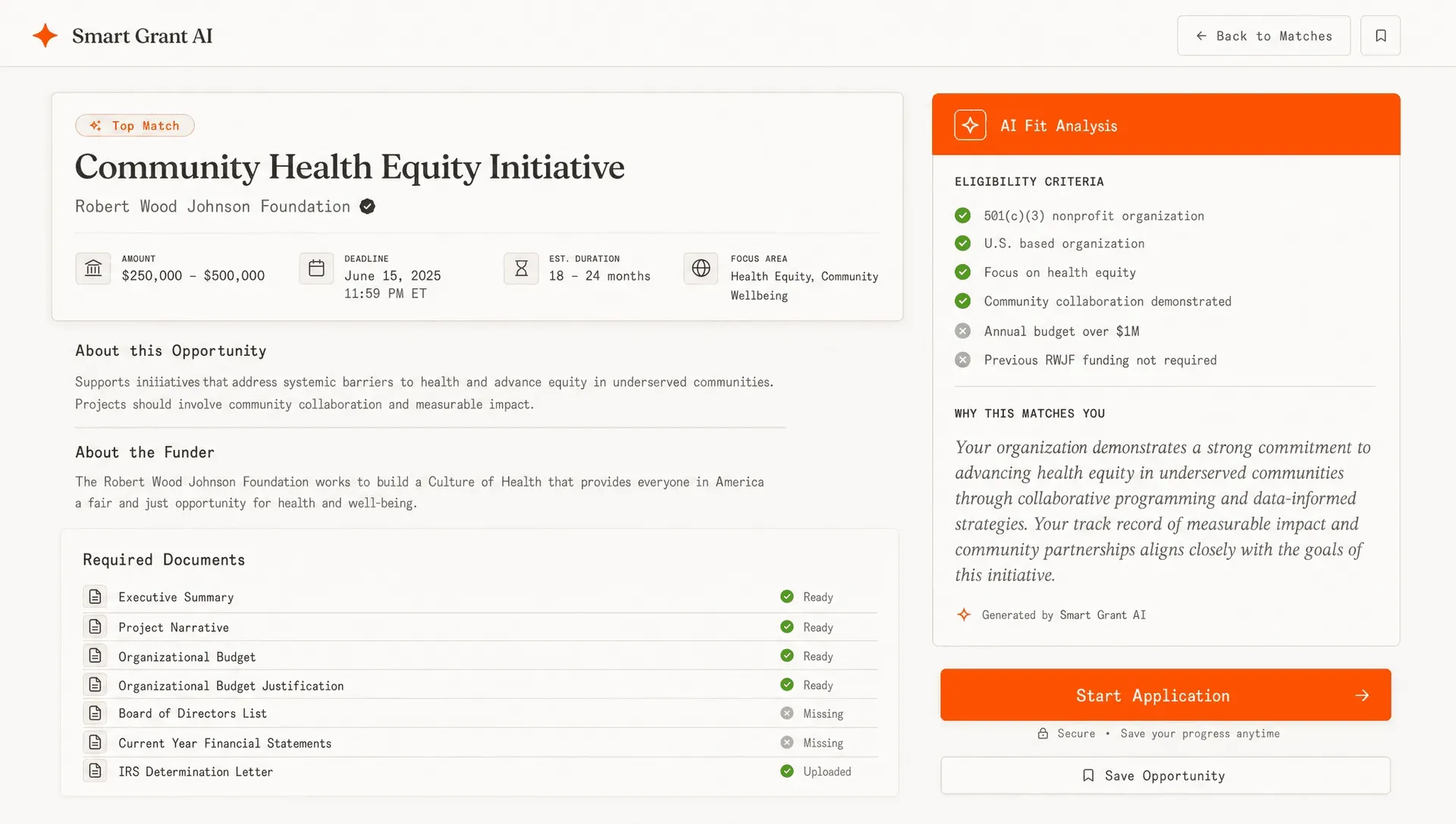
SmartGrant crawls multiple German funding portals, translates and normalizes program data, and builds a semantic vector store (OpenAI embeddings + Pinecone). Users describe their company or upload a PDF profile; the system searches 500+ programs, ranks matches using a custom relevance score (deadline, location, domain), and uses GPT-4 to produce prioritized recommendations and draft application documents (DOCX).
A Streamlit UI provides an interactive chat, RAG-backed answers, PDF parsing, and persisted session/history via PostgreSQL. The pipeline includes Selenium/Playwright scraping, DeepL translation, data cleaning, and python-docx generation — enabling a near end-to-end automated assistant for funding discovery and first-draft application creation.
This is an internal research project and is still in prototype Phase.
Key Challenges
- Data heterogeneity & freshness: Funding portals have differing schemas, frequent updates, and rate limits — making reliable, up-to-date aggregation difficult.
- Multilingual extraction & fidelity: Accurate translation and meaning-preservation from German legal/administrative text into English summaries is non-trivial.
- Relevance & legal compliance: Ranking must consider fine-grained eligibility constraints (legal, regional, timeline) to avoid false positives and reduce wasted effort.
AI solution
- RAG + semantic search: Use OpenAI embeddings + Pinecone for fast semantic matching and retrieval, then feed RAG context to GPT-4 to produce accurate program recommendations and justifications.
- Hybrid LLM workflow: Use GPT-4-turbo for recommendation and application drafting; use GPT-3.5 (or lighter models) for summaries and low-cost paraphrasing to reduce cost.
- Relevance scoring + rules layer: Combine vector similarity with rule-based filters (deadlines, eligibility, location) to improve precision and surface actionable opportunities.
Results / Benefits
- Time saved: Reduce manual search and first-draft application work from days to minutes for each opportunity.
- Higher match quality: Semantic and rule-based ranking returns fewer false positives and more actionable matches.
- Faster go-to-application: Auto-generated DOCX drafts accelerate the application cycle and increase throughput for consultants or SMEs.
Resource efficiency
- Labor efficiency: Automates repetitive research and drafting tasks — lowers human-hours per application and reduces consultancy costs.
- Compute / cost optimization: Tiered model use (GPT-3.5 for summaries, GPT-4 for drafts) reduces API spend while preserving quality where it matters.
- Reduced travel/printing: Digital document generation and precise matches reduce the need for in-person consulting, physical submissions, and printed paperwork.






Get to know more


HAVE A COMPLEX IDEA THAT YOU WOULD LIKE US TO IMPLEMENT?
KICK OFF WITH A DESIGN-THINKING PILOT OR A CONSULTING CALL.